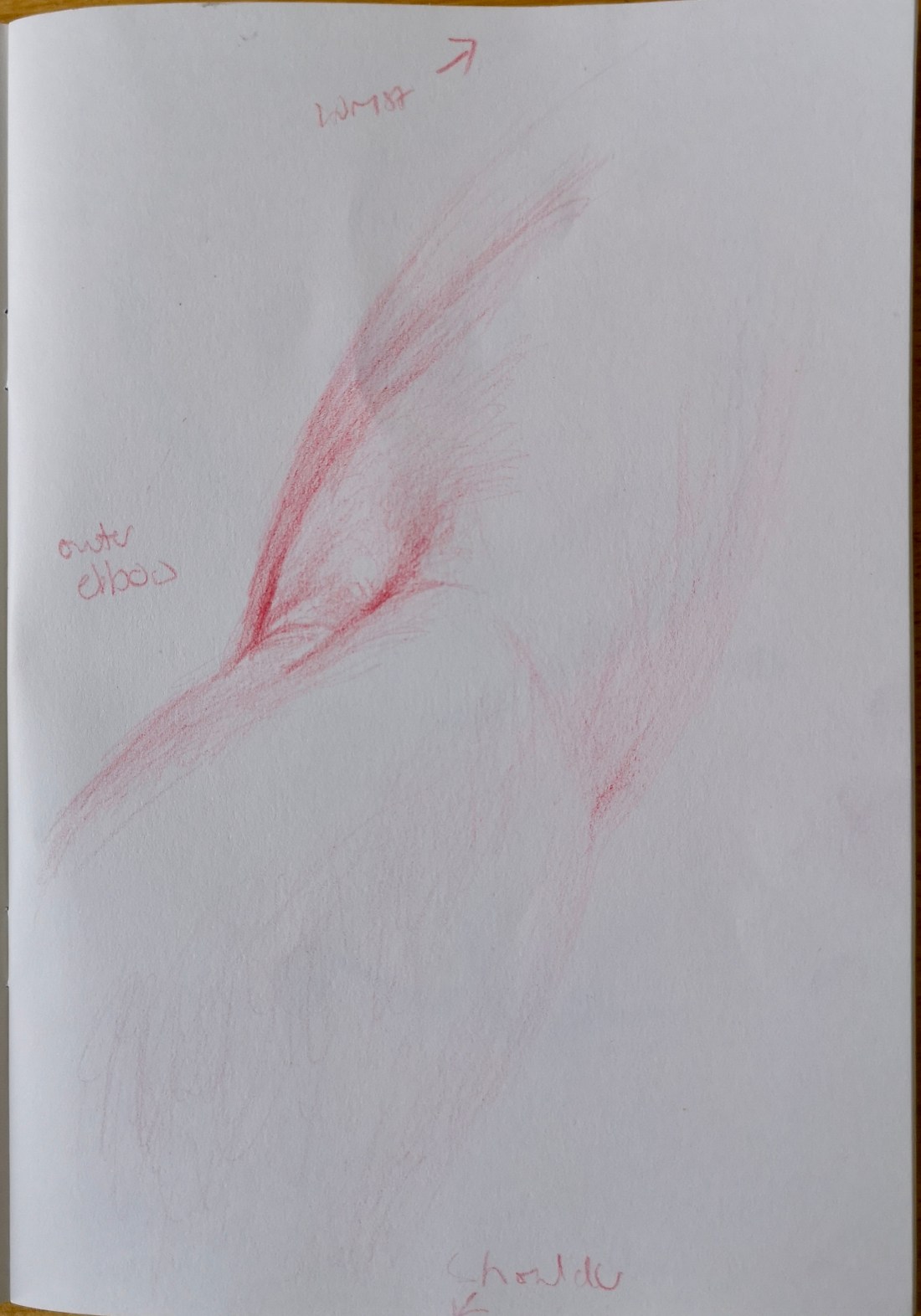
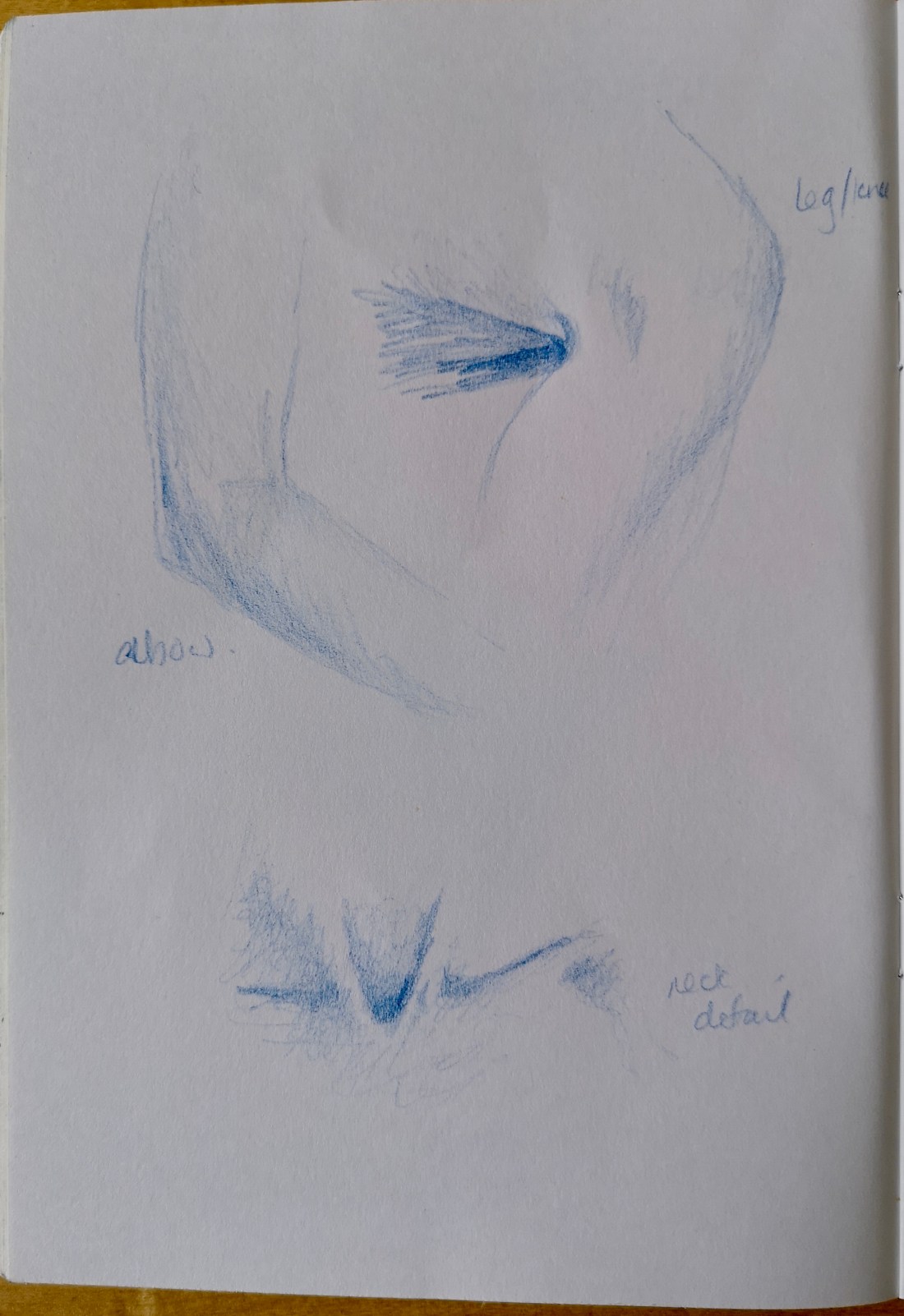
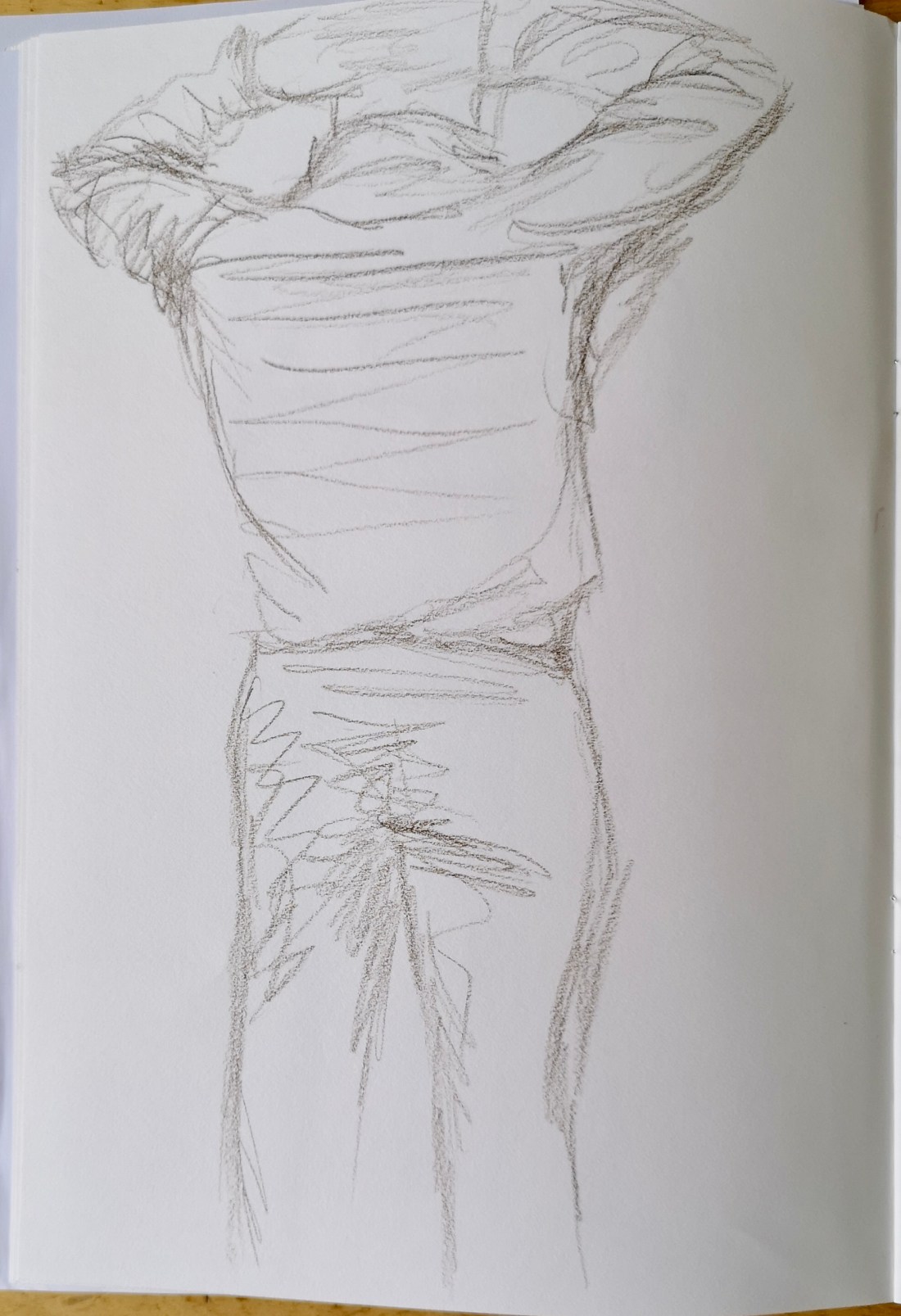
Drawing Skills 1: Pt 4; Additional exercises following tutor feedback

Amendments to line drawing of seated figure

My tutor had suggested that this piece would benefit from varied thickness in the lines. I questioned whether this changed the authenticity of the drawing as it was completed as a continuous line, but she explained that the integrity of the drawing remains intact, that I would be responding to the original drawing.

I therefore first looked at the drawing in comparison to the photograph I had taken and decided that the areas of greater shade were where the amendments were required. I thought about whether to use a different medium for example ink with a thick brush, but decided to stay with the original black sharpie pen. I went with the intention of building up the lines in the particular areas I had chosen, but as I approached the paper I immediately began to draw additional lines and to instinctively build up the lines in those areas, I continued with this process and it felt quite fluid, therefore giving me confidence as I proceeded. I also began to add lines where there were none before, but felt this gave more substance to the image.

I continued until I felt happy with what I had done.

Image 1 below shows the comparison between the original on the right and the amended version on the left.

B33AD4DA-0C64-4FF1-B547-41DA3CB5FA00

Image 1


Amendments to tonal drawing of lying figure

This exercise was particularly difficult for a number of reasons; to be honest I was feeling fed up and disillusioned with the course and really struggling to gather together any motivation or to harness any creativity, I also felt the clock ever ticking away on my final part of the course which I hadn’t yet started on and was in turn feeling a lack of motivation for. I had also invested a lot of time and energy in the initial piece so the thought of having to go through that again was also daunting, especially with Christmas around the corner.

I therefore decided to approach this piece from the very beginning again, rethinking my style and approach. I kept a diary of my thought processes throughout as well and found this a good way of aiding reflection as I progressed.

I first reflected on my initial piece and what I liked about it. There were elements of the background and of the figure that I liked but the two were different which added to the awkwardness. Whilst I liked the pose and the perspective, it felt quite staged. Additionally the assignment called for A1 and I was pleased I had achieved this, but I did not feel that I had been able to command that space with the drawing and I did not feel that anything was gained from it either.

I therefore began by looking at some art online to find styles that I liked, I also searched for tonal drawings to help guide my search, which directed me to monotone drawings using mediums such as pencils, charcoals and ink. I decided early on to use a smaller ground size to keep it manageable. I also decided that I would use a different pose for the drawing. I did not want something that was staged again, and I was unable to capture a spontaneous pose so I went through my digital photos hoping for a better picture and found one of my husband lying on deckchairs when we were in Paris just over a year ago. I was immediately drawn to it because it was portrait orientation, and had great tone because of bright sunlight. It was also the spontaneous and natural image I was looking for.  From my research I had also decided that monotone may be more effective for a tonal drawing, I also thought this may help me to build more effectively on my use of tone. I liked the idea of conte sanguine colours, so I did a little sketch and it was ok (see image 2), but started to worry that I wouldn’t be able to get enough detail. I then saw a fellow students ink drawings and got inquisitive, and after a follow up google image search, got inspired – well enough to have a practice (see image 2). As with the conte drawing I tried to keep a loose style as I had been working on this due to weakness in this area. The practice with ink was ok, although I felt I tended to use the ink as a painting tool rather than for drawing, but I was also more drawn to developing this further. After much reflection I decided I just needed to let go and see what happened on a larger scale.

cof

Image 2
I used white A2 paper, and a small paint brush with black ink. My drawing started well, but the brush didn’t work well for larger areas. It was much better when I swapped to a larger brush but then began to look really messy so I stopped to reflect and it was only at this stage that I realised one leg was out of proportion (see image 3). I thought I may be able to salvage the image but was more tempted to give up on it. I thought a lot about other pieces I had had problems with in the past and subsequent discussions about them with my tutor. I thought in particular about what I may be able to remove or take away from the image and considered drawing over the left leg to correct it and of using gesso to add highlight at a late stage where I had gone too dark. I also thought that it would be good to do a few more small studies again with different mediums as well as ink to practice more. I spent a few days just looking at the image and thinking it over.

I again began to feel the pressure of time and felt that if I did not finish the image within a few days that I would move on to something else with the hope that a bit of distance may help and I needed to get on with other things.

I therefore tried another version with conte sticks on coloured paper, building on my initial practice sketch (see image 3). I remained insistent on using a very loose approach but again got the proportions wrong although otherwise, I was quite happy with the tonal effect. At this point I became really fed up. I wanted to walk away from the whole thing, but couldn’t even stop thinking about it. It was as if it had become my nemesis.


C801C33A-F996-4B9E-907C-7A7170285A7D

Image 3


At last I had an epiphany – I began to re-evaluate my whole approach; why was I so insistent on rushing through with such a loose style? Why was I so against using pencil? When I did this I knew that graphite pencil as a basis for the image was the way forward. I used grey textured paper of close to A3 size, and thought that I would also use conte sticks along with the pencil for shadows and highlights. i started first with a 2H pencil to loosely draw the broad shapes and dimensions then zoned in with the 2H along with 4b and 8b for detail. I moved between the 2 approaches – to ensure I kept my mind on the whole image. This really worked. Although I did feel a bit annoyed with myself at returning to a very detailed image, I realised I’d actually gained much more of a balance this time, using the different styles in a better way to the best effect.

Once the figure was complete I then decided to use a green pen for the chair. I felt it would really complement the image. I really didn’t want to add background other than the shadow, so by making the chair stand out I felt this helped ground the image without the need for further background detail. I am really pleased with the final outcome (see image 4), I feel it’s the best piece I’ve done in the whole course. The whole final process went well and didn’t feel like it was just incidental as had felt before, rather it was a methodical approach which built through trial and error and drawing on prior research.

e1e9a4c3-0bba-40f4-b8e4-359f90c30858.jpeg

Image 4

Additional portrait

This exercise caused me the most angst as I really did not know what exactly to do and I really struggle to work beyond specific instruction.

I really didn’t know where to start with this but had lots of thought. I considered whether using different media for the same image would produce different results – i.e would it change the intensity or intimacy, would it have an impact on the interpretation of the piece. I also wondered about doing additional portraits using the same media (as the original) but of different poses, perhaps something different to reflect another element of the model’s personality.

Although I liked the idea of a different pose with the same media, I tended to steer away from this instinctively. I found myself coming back to the iidea as to whether different media and different styles would give another dimension to the initial portrait.

To start, I used black conte stick on a tinted paper. I used the same photo to work from but it was not zoomed in as far – this was by mistake. I really struggled to get the dimensions. I’m not sure if this was just more evident because it was easier to see with the contrast of the medium against the paper. I worked quicker than I had with pencil, but it was much easier to make a mark using such a dark medium. I also found that although I was working in a similar way to the coloured pencil it produced a much harder image with more severe features. It was also very unforgiving as it was harder to cover mistakes. I felt the way the image progressed led me to concentrate on different features such as lines on the forehead. When I compared the 2 portraits side by side, I was interested that the colour one appeared even softer than before (see image 5 below).
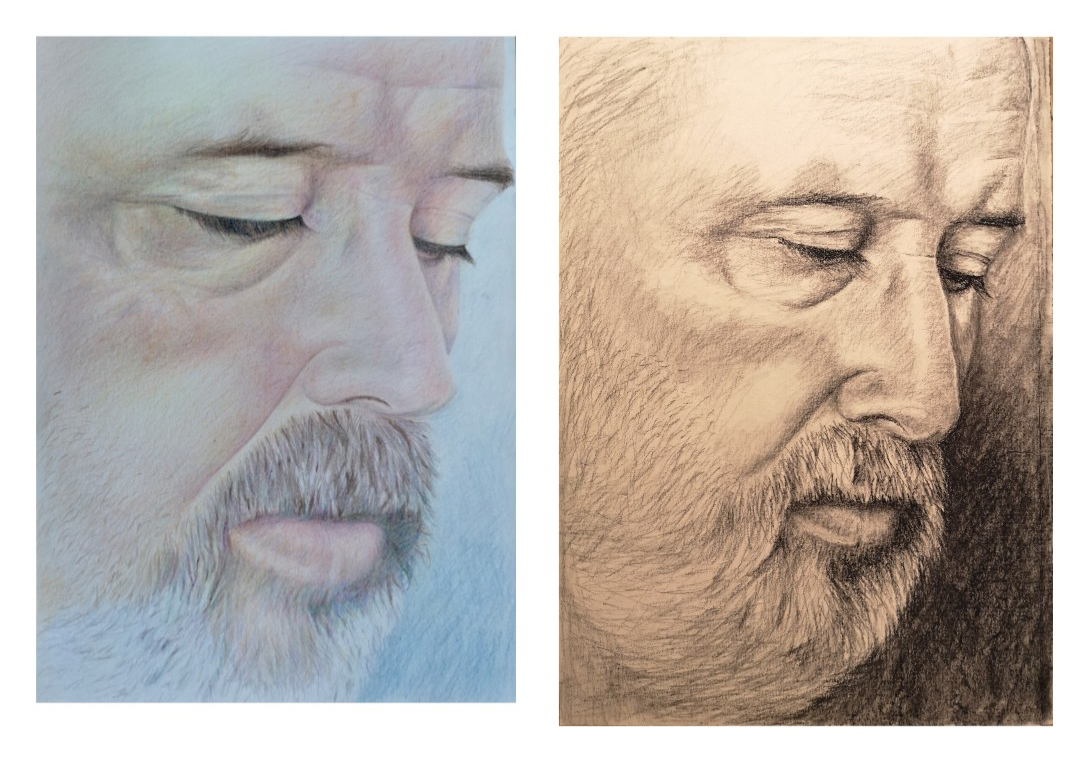
e1309cb2-4c62-44fc-94de-bc25745e66c8.jpeg

Image 5

Although I felt the above was successful I felt this was not what was called for and felt it necessary to continue exploring. I was particularly interested in using biro with ink washes. I was not sure how I’d manage this as the washes would need to be very subtle and may have required some mixing. I was thinking it may be better to apply the wash first and then draw over with biro.

I had a go at this. I kept the ink wash really simple but was very pleased with the effect, so much that I was tempted to leave it there as it kind of had a reminiscence to my models face. After a few days, however I felt I had to do more so began drawing the portrait over the wash with a biro. I resorted to my usual style, laborious measuring and estimating before committing, being wary of making any errors and becoming very focused with how it should look – what had been in my mind as the finished piece. After an hour or so, I stepped back and realised the proportions I had laboured over were completely wrong so I destroyed the image in complete frustration. See image 6 below for stages of the drawing as described.

986b68e2-6884-42ac-b618-f222fe890f61.jpeg

Image 6

I decided after this failure that I had to do some more practice before attempting again. In the meantime I had begun to reflect over my earlier coursework in preparation for assignment 5 and was reminded of my need to loosen my approach to drawing, I therefore concentrated on doing quick sketches with the aim of loosening my drawing style, this was quite successful on a smaller scale (see image 7).

82EDD892-85C1-4092-BC8E-6F874AC1155D

Image 7

I remained quite anxious about trying again, going over and over in my head what outcome I was aiming for. Eventually I just bit the bullet, I decided against using biro for the final version and chose instead my old adversary charcoal (albeit the pencil form) and just tried to deploy the same loose approach to the same portrait. I couldnt believe the results, after just a few quick scribbles I more or less had the portrait complete! It wasnt complete in the same sense as the previous one, but had all the necessary elements to be recognisable and the proportions were fine too. I left the drawing over night as I was unsure whether I needed to do anymore – in part I felt guilty that I hadn’t put more effort in. The next day, I added a bit more shade to suggest form but not much. I was really quite nervous about leaving it or doing any more, when I realised that everything I had done really showed how well I knew my model (my husband), how intimate I am with Him, and with that I was satisfied that I did not need to do anymore – this was a very personal image and for me perfectly complements the original portrait. Image 8 shows the charcoal portrait next to the original pencil portrait.

982CB5DC-3432-4CF5-9B82-9B63C942B1AF

Image 8

In all the amendments actually took longer than the original assignments but through the process I felt I learned more and progressed further than I had the first time around.
 

Drawing Skills 1: Pt 4; Reflection on tutor feedback

Reflection on Tutorial

I had given some thought as to what I wanted from this tutorial. This was the first time my tutor had seen my work in real life rather than just via my blog, so I really wanted to hear what she had to say, but other than that I was mostly concerned with how I needed to approach assignment 5.

On the day of my tutorial I was not feeling too well, so not sure I was very enthusiastic and I kind of felt lost as to how to critique myself although have been reassured this will come over time.

In terms of feedback I felt the same things came back up, about being more explorative as well as thinking about what to do with a piece when I feel its wrong – again consider cropping or presentation; is it about the context rather than just thinking about what to do in a drawing sense?

With regards to part 4 specifically my tutor had the same preferences I did, i.e. she really liked the portrait, but felt the lounging figure seemed awkward and could be re-done. She suggested however that the portrait would benefit from another alongside, and that my line figure could do with some further work to vary the thickness of lines.

I didnt really explore her suggestions further and we talked more about part 5, which I had most anxiety about at the time. She reassured me that I was on the right track in terms of reflecting over the whole course so far, checking I have done all the course work as well as additional work suggested by her through feedback, and then to let that take me forward for a final piece. I briefly talked about how I had been struck by an interior view in my home, which made me think about line and tone and in her written feedback she suggested that if I was to explore that further I may wish to look at Edward Hopper. I looked him up briefly and liked the alternate view to everyday scenes in his work, I found them a bit voyeuristic, though not uncomfortably so, but also interesting in the way that he blended structures with people and light.

This prompted me to look again at negative space as a search term, which in turn led me to lots of images of items simplified against negative space and then to a flood of ideas as to how I may explore my interior view further.

To conclude part 4, I have to complete the following:

1 – return to line drawing of seated figure and look at adding varying lines to develop further.

2 – re-do drawing of lounging figure in tone.

3 – complete additional portrait to compliment original piece.

Drawing Skills 1: Pt 4; Project 6 The head – Ex 3 – Portrait from memory or the imagination

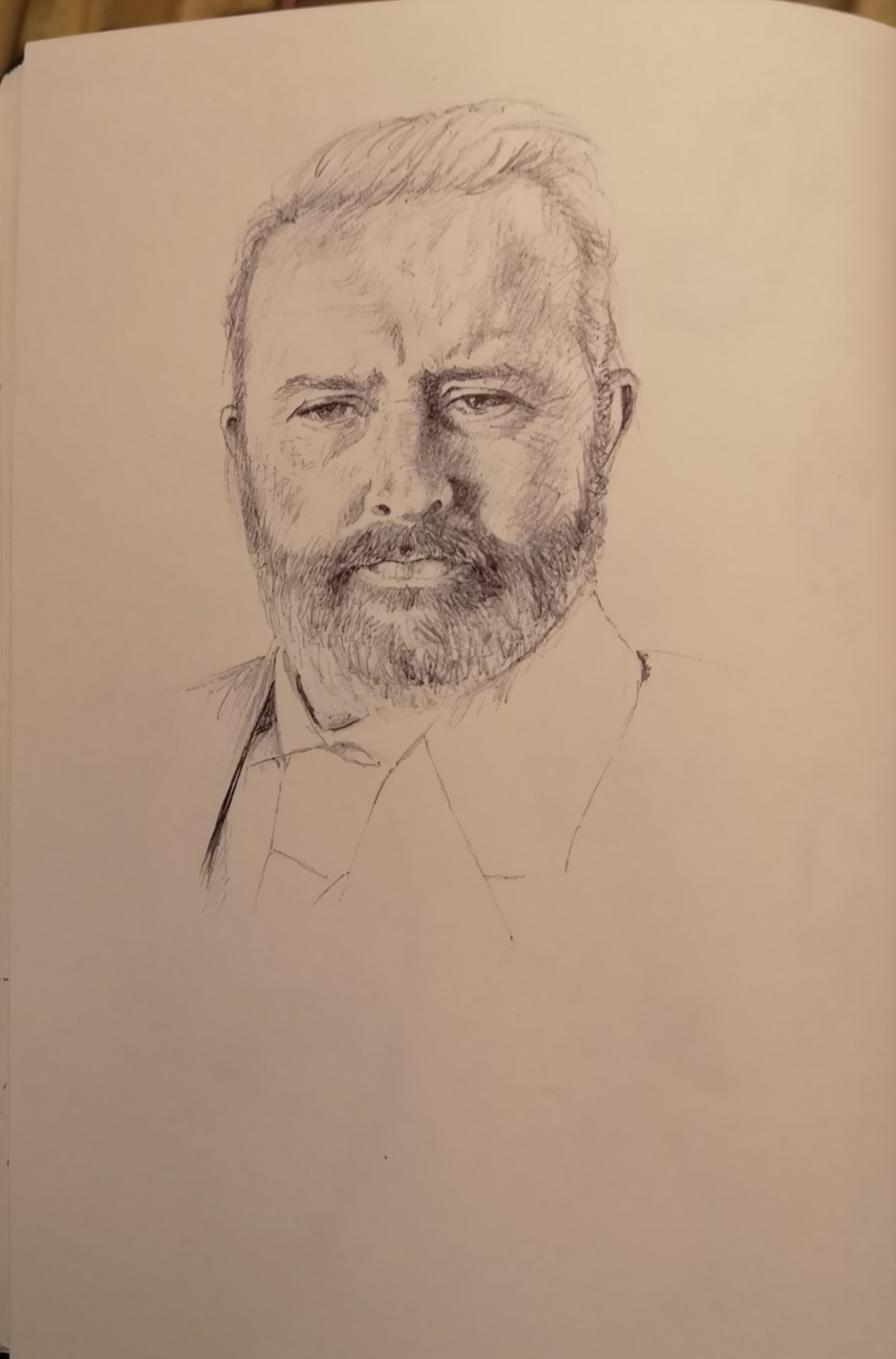
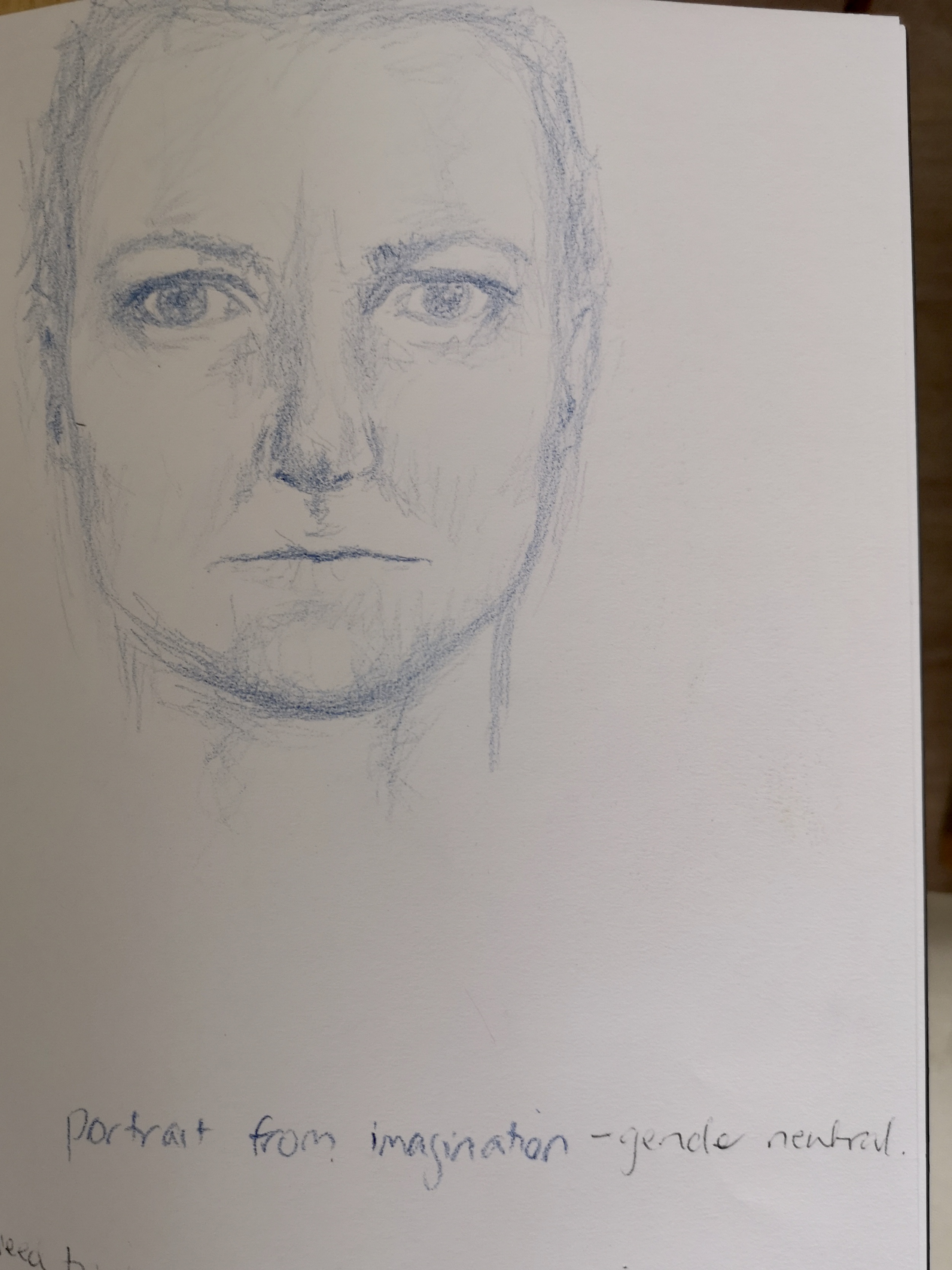
I completed this final exercise quite quickly, and used the method that I am more used to and familiar with, i.e starting from top to bottom, and with outlines before building on tone.

I found it much easier to get proportions right, I suppose being able to create the image as I went along enabled me to adapt where working from a real person would not. I didn’t have anyone in mind, but just let the portrait evolve as I went along. I didn’t have any gender of portrait in mind and as it developed I decided to keep it gender neutral.

D603E447-3FAD-4E17-AE49-3CDB46A67071.jpeg

Drawing Skills 1: Pt 4; Project 6 The head – Ex 2 – Your own head and research point

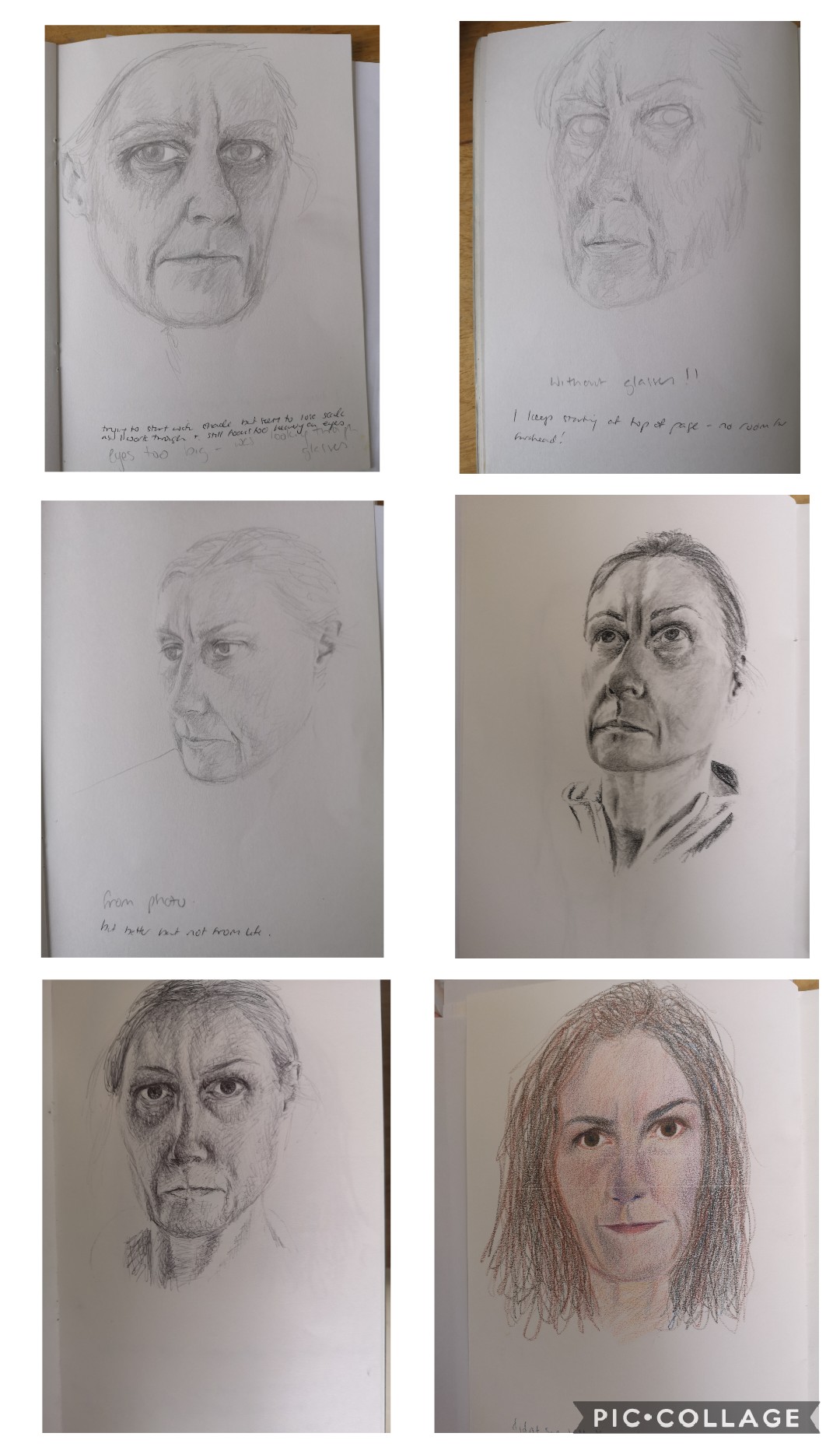
I really struggled with this, mainly due to wearing glasses – I need them for close work only, so needed them to draw but not to see myself in the mirror. I therefore wore them low down, but this affected how my eyes appeared each time I looked in the mirror. I could not draw myself wearing them as to wear them I would not see myself properly! Hence I ended up with quite a few sketches with huge, disproportionate eyes. I tried one sketch without my glasses which I thought went well until I put my glasses on to look.

I also found the technique encouraged in course material to be difficult to follow so I returned to my usual technique which I found more logical – working from top to bottom, starting with rough outlines. I had better success sketching from a photograph – one was in pencil, and the other was in charcoal – the charcoal version was a bit distorted but more proportionate.

I made one last attempt with a live self portrait, this time I used colour pencils, and thought I was doing very well until right at the end when I realised that I had moved my position over the course of drawing resulting in a twisted face with nose and lips slightly side on and eyes straight ahead.

I showed all my attempts to my husband, he felt that whilst I’d captured some elements of ‘me’ he felt I quite often created a much harsher version of myself, he said in particular I was very heavy on the area around my eyes and accentuated my nose, whereas he felt my features were much softer.

Below are all the sketches I made.

01B3B313-5D23-4934-87C4-E9D9D02B7697


I felt quite despondent after this exercise, but it got me thinking about how I see myself and that I would never be able to see myself as others do so how do I create an accurate self portrait?

For my own development I will continue to attempt live self portraits, but I think I will have greater success practising from photographs in the meantime. 

Research Point

To research this genre, I looked at 2 historical and 2 more recent artists, famous for the genre of self portraits.

Rembrandt was a Dutch painter in the 17th century who is noted to have completed several self portraits over his life and particularly in later years. These are also observed to have reflected his apparent time and situation in life as well his artistic style. His self portraits are styled in teh traditional sense, looking slightly sideways towards the viewer, and Were completed in oils which was his medium. I looked at one of his later portraits, completed at teh age of 63 and this was painted on a very dark background with very thick and loose brushstrokes. He uses light to denote the features although these are not detailed but rather suggested. However the painting is also unsympathetic and clearly shows him with all his flaws.

Vincent Van Gogh was also a Dutch painter who practised for less than 10 years in the 19th Century but in that short time produced over 2000 artworks. He is also well known for his self portraits and his expression of emotion through his painting style. His self portraits were mainly completed to perfect the art of portraiture so again reflect his style and at times appear experimental in the use of colour and brushstroke, as well as the slight variation in position of the head and clothing etc. Most of the paintings are in the style most well known i.e. short, dynamic brushstrokes and vibrant use of colour to denote the light, skin tone and hair colour.

Kathe Kollwitz was a German artist who worked with painting, drawing, printmaking and sculpture. Her drawings and paintings were primarily studies for her prints. She was noted to be concerned with the realties of life affecting working classes, and in particular much of her later work centres around the themes of motherhood and death. She created many self portraits which provide both a record of her life but often show her own depth of emotion and feeling. Her portraits take the style of drawings often with charcoal, using very broad sweeping strokes, often with teh use of heavy contrast to denote features which similar to Rembrandt are only very suggestive, yet very detailed at the same time – i.e. she cleverly provides enough information for the viewer to recognise what is being expressed. Her poses are not in the traditional sense, some are side on but always with a deep sense of expressed emotion – sadness, despair, angst; the abs ensue of colour and fine detail seems to help communicate these feelings.

Frida Khalo was a Mexican artist active during the 20th Century. She is noted for her very vibrant use of colours drawn form her cultural heritage as well as the use of realism, symbolism and surrealism in her art. She completed many self portraits over her life, most of which use the same traditional and familiar pose of a portrait, however many often depict a scene or use objects, dress or other symbols to represent an aspect of her life or emotional experience. Her turbulent marriage and physical pain are 2 subjects which feature frequently. In depicting her own facial image, each is also most identical and seem to me almost like a caricature with heavy eyebrows and the same stern, serious expression. The detail and definition of her form and features is clear, brushstrokes are not evident, the image is smooth, but unlike with the other artists I researched, the use of light is not a characteristic of Frida Khalo’s paintings, they are much more of an illustrative style.

In all the artists I researched the use of themselves as models for their paintings was in part autobiographical in terms of both providing a record of themselves, but also providing viewers with an insight into their state of mind or condition at that time (whether intended or incidental) – in the case of Frida Khalo this seems to have been the main purpose of her self portraits. However, there is also a basic and much more simple function – that they were an available and free to use model for their own practise and experimentation which makes complete sense, however having attempted to practice the self portrait myself I am in awe of the way that they were each able to in some way step outside themselves and draw or paint what they saw before them without their own skewed perspective of themselves.

On reflection of this whole subject including my own practise, I feel that self portraits are the ultimate skill in observation. As I said before I can only practise, but I think that to draw photographs of myself first may be the best way to start as this had the most initial success, and will help me to get practised in drawing my own form, hopefully this will then help me to see myself better when practising from life.

References:

Frida Khalo Foundation (2019) Frida Khalo Foundation [online]. [Accessed on 07/11/2019]. Available from: http://www.frida-kahlo-foundation.org/biography.html

National Gallery (2019) National Gallery: Rembrandt [online]. London. [Accessed on 07/11/2019]. Available from: https://www.nationalgallery.org.uk/artists/rembrandt

Van Gogh Museum (2019) Van Gogh Museum: Self portraits [online]. Amsterdam. [Accessed on 07/11/2019]. Available from: https:/www.vangoghmuseum.nl/en/search/collection?q=&artist=Vincent+van+Gogh&genre=self-portrait


Zigrosser, C (1969) Prints and drawings of Kathe kollwitz. Dover Publications Inc, New York.

Drawing Skills 1: Pt 4; Project 6 The head – Ex 1 – Facial features and research point

I found this exercise quite easy. I did some of the drawings from observation of my own face and others from photos. I find drawing individual features much easier than putting all the features together to scale, but when I did do this to draw a whole head (again I used a photo) I actually found it quite easy again and proportion seemed to be good apart from a slightly wider face than in reality. The photo was my husband so, as I see him daily and know him intimately I think this made drawing him a bit easier; I know his features really well and can tell if I’m going wrong very quickly.

8E243CBD-B636-4C2D-ADCA-5528812232E4

Facial features – Ball point pen, fine liner pen, graphite pencil and coloured pencil on paper


mde

Full head – Ball point pen on paper

Research point

According to philosopher Cynthia Freeland a portrait is defined as a work of art drawn from a person posing for the artist and which gives a visual description of the sitters character or personality.

Historically painted portraits were mainly used to depict people of power and influence not only to provide a record, but also to demonstrate their wealth and importance to others. Painters were commissioned and most often depicted their sitter in a flattering way and in more or less similar poses.

In the 20th Century portraiture changed particularly with the introduction of photography and many artists used the genre to demonstrate or experiment with their painting techniques.

For the purpose of this exercise I looked at contemporary artists, some of whom were recommended by my tutor and others in the course material.

Marlene Dumas often uses reference material such as Polaroid’s as well as images from magazines and pornographic material for her portraits. Some are of the whole body and others just head and shoulders. Whilst they are defined as portraits they are not all images of people who have posed for her and on the whole seem more to do with exploring the human experience in terms of emotion, prejudice etc. Her bio notes that she focuses on serious issues and themes such as sexuality and race, guilt and innocence, violence and tenderness.

Her techniques involve use of different paint media such as oils and inks, but always in a similarly soft application, very loose and blurred lines with limited detail. Despite the lack of apparent detail she is able to convey a particular look or state of being which at times appear ambiguous or unnerving but encourages close inspection, It is only the accompanying narrative that the true background or subject of the painting is uncovered. Her works tend to be completed in series.

I think that whilst they are not portraits in the sense of the definition above, they are portraits of the human condition, they offer something that we recognise in ourselves or others, so something that all humans share, this is perhaps how her work is able to provoke.

Annie Kevans similarly uses photographs and found images as well as her imagination. She also paints in series around particular themes which challenge and provoke. Her portraits all have a similar format -usually head and shoulders looking at the viewer and are often of well known people from history or contemporary culture and are immediately recognisable. Her style appears very simple, minimal, thick sweeping lines which denote the main form and features, with few colours. All are painted of a light ground and serves as both infil to the faces and background to each portrait thereby creating a very a very distinctive look which is common across all her portraits. According to her bio she is interested in power, manipulation and the role of the individual in inherited belief systems and through her portraits wants to create alternate narratives.

I particularly like the way that these portraits appear to have been painted with such ease, and how whilst having very limited detail they are very recognisable.

Sally Muir does portraits of animals and landscapes as well as portraits of people. Her website does not provide much information about her methods, but her brush strokes are clearly evident with often patchy application. Many of the portraits look half complete, but as if just enough is done to capture the essence of the person. What is most evident are the eyes; the direction of gaze seems to be the focus and what captures the essence of the person portrayed although a couple of pictures have eyes smeared out. Each of portraits appear as a real snapshot and quite lively. that part which draws the viewer and says everything about what is happening.

I particularly like the unfinished elements of these portraits and how each one has so much movement and expression captured.

Francis Bell all her portraits are painted in oils and from live sittings. They are all recognisable as portraits in a more traditional sense and often include a setting which appear to give a sense of the sitters life. All are in a very relaxed style and she has also completed many of her own family. Her method is very soft and gentle but with application of paint very evident, there is also a wide application of colour evident and the use of light is often a feature. Each painting seems to emit a sense of tenderness and intimacy.

The gentleness and intimacy is what strikes me most about these portraits, I think this is mostly achieved through the painting technique and use of light which is reminiscent of the impressionist style.

Elizabeth Peyton style is likened to the pre-raphaelites and a romanticised illustrative approach to portraiture, emphasising beauty or what is considered as such. Words used to describe her work are fictionalised, decorative, nostalgic. She also works from photographs although often portraying people she knows. Her subjects often appear to have the look of a sultry looking model in a nonchalant pose, rather than a true pose. model rather than posing. Her marks are very evident and each subject has a similar look; long slim face and fine features. Many of her images appear unfinished but have a very stylistic yet sketchy quality.

I particularly like the pencil portraits, even though they appear very soft and elf like, her marks are very strong, and the results do not appear too contrived.

Graham Little puts his models into fashion labels and poses them very purposefully. He uses coloured pencil and very soft illustrative style. His portraits are whole scenes where it is evident that everything in the image plays an important part. Whilst all sitters are posing it does not appear that they are revealing anything about themselves, they are just there as part of the image.

I really admire the amount of detail within the portraits and the style is almost dreamlike, but I feel that they are less like portraits as the focus is on the whole scene.

References:

Bell, F (2019) Frances Bell Paintings – oil portraits [online]. [Accessed on 23/10/2019]. Available from https://www.francesbellpaintings.co.uk/home/oil-portraits/

Hoptman, L (2005) Drawing now: Eight propositions. Museum of Modern Art, New York.

Kevans, A (2019) Annie Kevans [online]. [Accessed on 23/10/2019]. Available from https://www.anniekevans.com/

Muir, S (2019) Sally Muir – portraits [online]. [Accessed on 23/10/2019]. Available from https://www.sallymuir.co.uk/portraits

Philosophybites (2019) Phylosophy bites – Cynthia Freeland on Portraits [Podcast]. 11/09/2010. [Accessed on 23/10/2019]. Available from https://philosophybites.com/2010/09/cynthia-freeland-on-portraits.html

Tate (2019) Tate: Art Term – Portrait [online]. London. [Accessed on 23/10/2019]. Available from https://www.tate.org.uk/art/art-terms/p/portrait

Tate (2019) Tate: Maria Dumas [online]. London. [Accessed on 23/10/2019]. Available from https://www.tate.org.uk/art/artists/marlene-dumas-2407

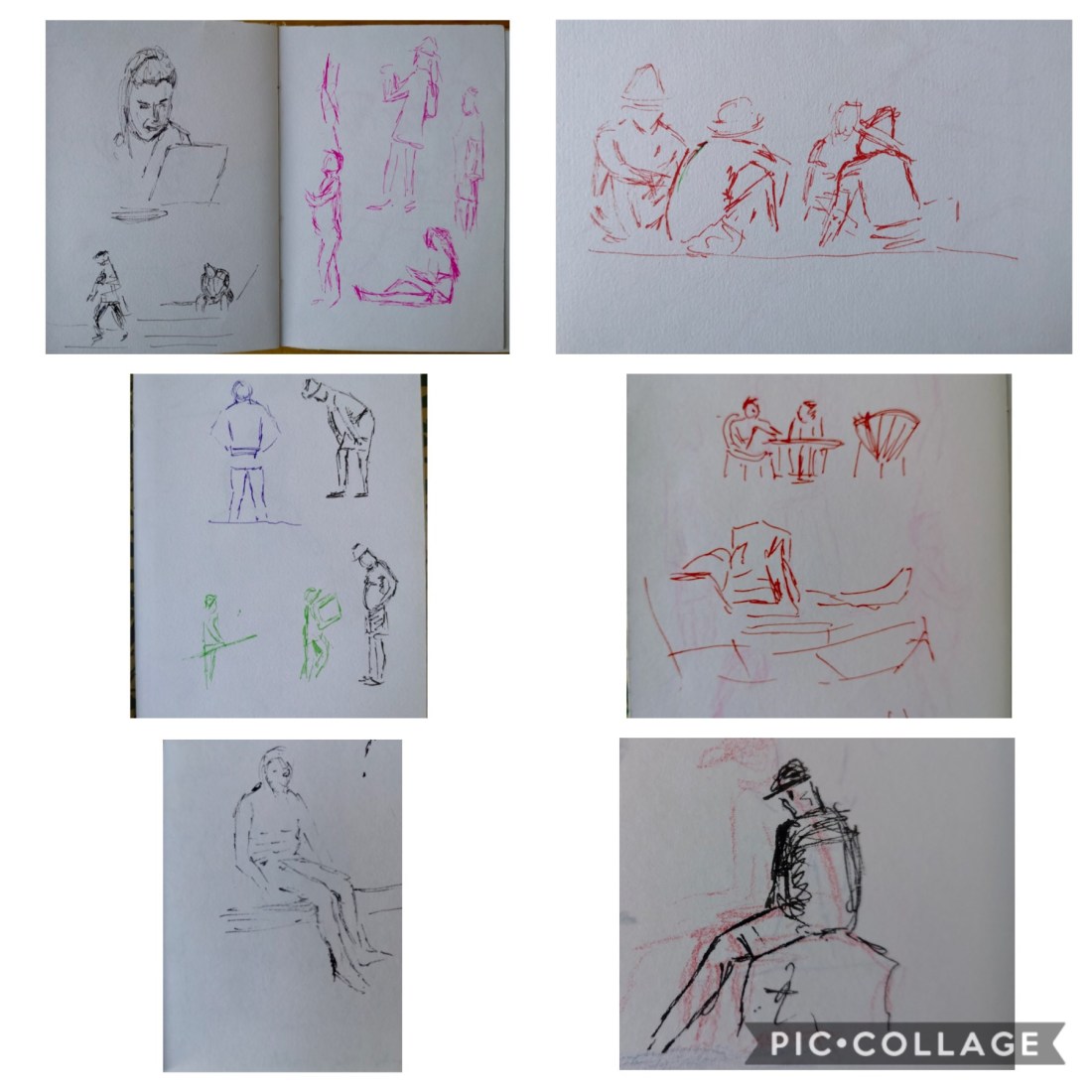
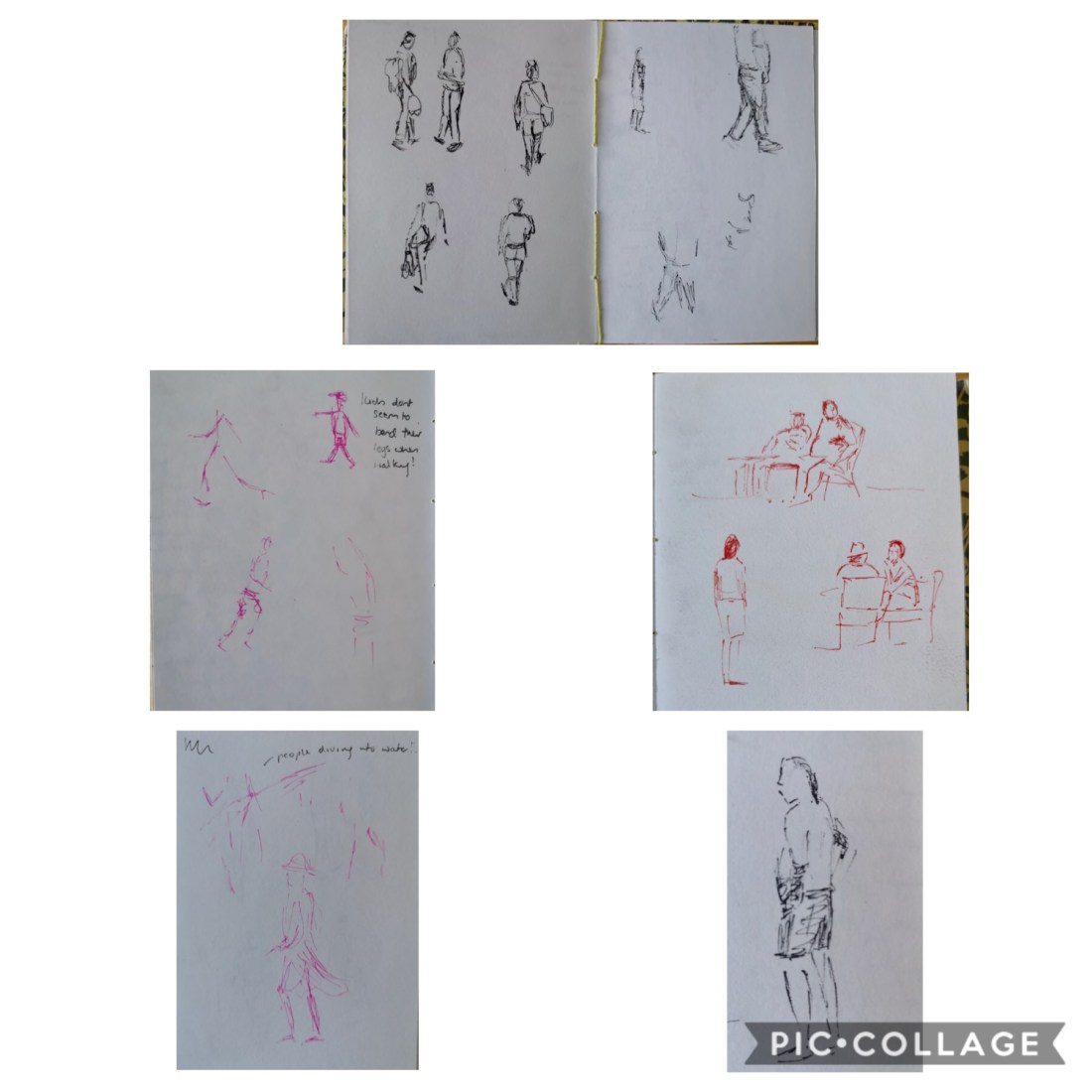
Drawing Skills 1: Pt 4; Project 5 The moving figure – Ex 1 – Single moving figure and Ex 2 – Groups of figures

I completed all these sketches whilst on holiday. I was very self conscious as I mostly did this whilst sitting on the beach, therefore most people were scantily clad and for that reason I generally didn’t take pictures to work on studies later.

Since returning home I haven’t really spent anymore time on this as I have been busy with other parts of the course. I think it’s something I definitely need to build into practice at least a few times a week. I found it really difficult to hold onto a mental image of people walking and haven’t mastered the art of drawing without looking so much at the paper. Even when people seemed to be still I noticed they moved a lot which made drawing difficult. However, that said I found the more time I spent looking and practising the easier it became even in a short period.

When it came to actual moving figures I really struggled, I saw so much movement that I wanted to capture but found it impossible to hold onto anything. I became so frustrated. Eventually I decided that perhaps drawing people as stick figures may help to get the movement captured quicker for me to then build on, this helped me a bit, particularly with gaining a sense of progress. After my initial failures, I then spent some time just looking out from my hotel window at people walking for around an hour and was able to capture lots of drawings which boosted my confidence.

Some of my images I was really pleased with, whilst others not so much, but I found it was all about trial and error as well as perseverance and sometimes just watching for a long time before actually drawing was most helpful. In the images I felt were more successful, there is definitely something about the way I have sketched and decisions I’ve made about what to add and what to leave out that makes the sketch work better, but I find it hard to get that right each time and I’m not really sure what the magic formula is, I just seem to get it every now and then.

FA3D2A86-14C4-4A70-BE1F-A3D77EA73D2A


Blah blah

33288AD2-DA18-4E5E-A4C7-5E17FC5FD238


Blah blah

Drawing Skills 1: Pt 4; Project 4 Structure – Ex 2 – Three figure drawings

For this exercise I was tasked to complete 3 figure drawings, one lounging, one seated and and one standing, however I only completed 2 due to time constraints. For both studies i completed a few quick sketches before settling on views which included foreshortening to add interest and help with my practice. For each final study I took a photograph to work from. I also used different mediums to explore techniques and effects especially as these were both completed on quite a large scale – A2. Whilst both figures were clothed i tried to remain mindful of the body structure beneath and was conscious of making the structure flow. As well as this in the standing figure i was more mindful of the central line, and how the arms were holding the body upright against the weight of the chair.

Both figures were challenging because of the views but also because of the medium used. Pen is not forgiving when mistakes are made and I found oil pastel was not good for detail. In particular I dont think the oil pastel worked for the dimensions of this image; I think it would be better if I was working on a much bigger scale or focusing in on a smaller area such as a large portrait.

With the first study, whilst I roughly scaled the image on the paper at the outset this did not work, as the scale ratio of the photograph to the paper was not true which I did not account for so had to change as I went along. Additionally, the tilt of the head was not accurate though I don’t think it matters, but the size of hands and feet seem smaller than they should be and as I said was difficult to correct because of the medium used.

I realise with these studies that I have a tendency to work on detail to quickly rather than working softly and gradually across the whole image until I have got the proportions right. This is something I really need to work on as I don’t seem to see this happen – I seem to get quite engrossed in what I am doing and did not become aware until quite far into my drawings and when it is too late often to make corrections.

0A461AE0-D03C-4C95-8348-FC938700A3CA

Preliminary sketches for lounging figure, conte pencil on paper.

9DA769A6-D129-45B8-AB15-956FE99ACBF1

Lounging figure, final study, ball point pen and coloured pencil on paper.

4D099275-9232-47C3-94EC-6041300D9AA3


Preliminary sketches for tanking figure, fine liner pen on paper.


8234144A-CB79-442C-B4F5-71DE847238CD

Standing figure, final study, oil pastels on paper.

Drawing Skills 1: Pt 4; Project 4 Structure – Ex 1 – The structure of the human body and research point

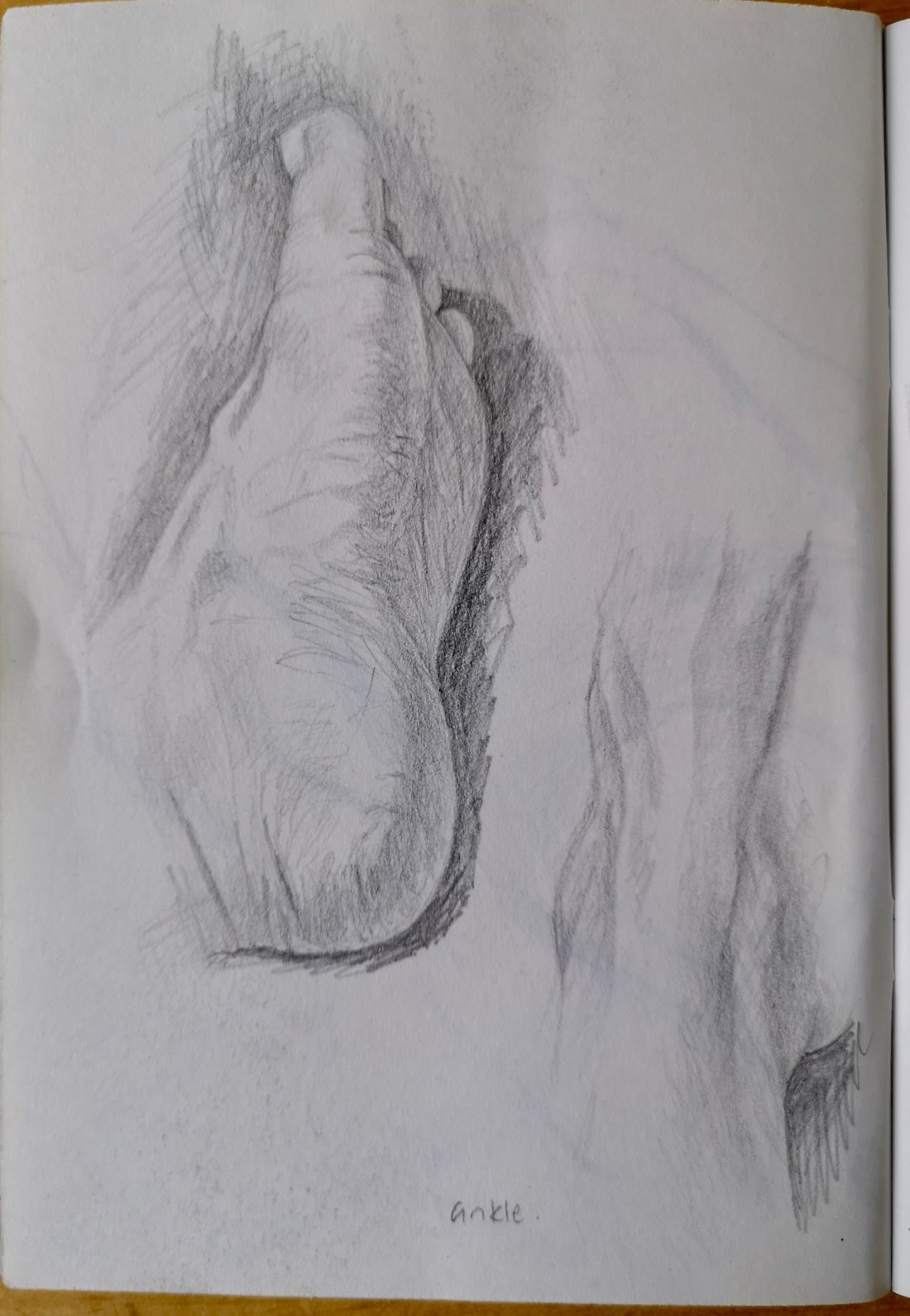
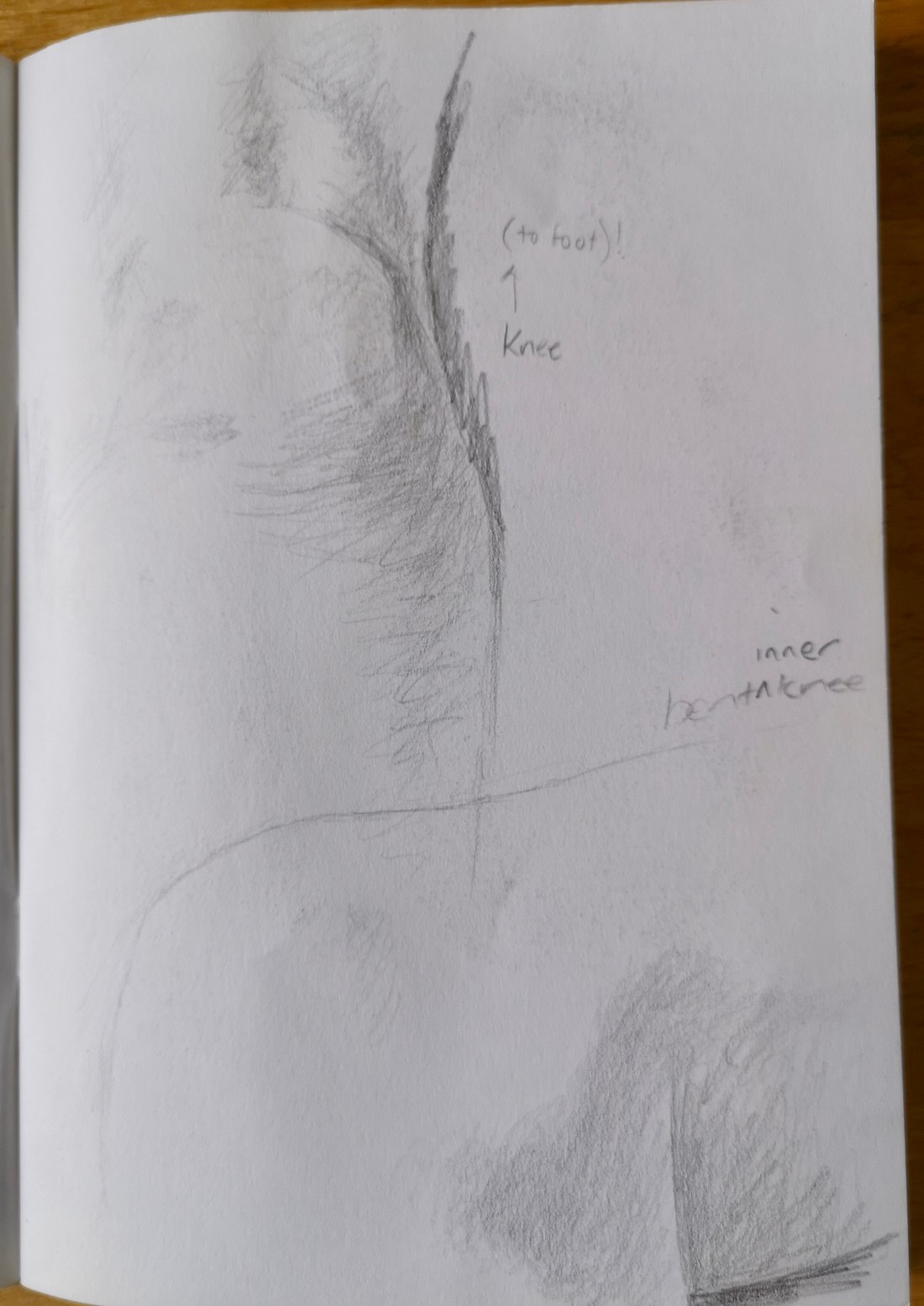
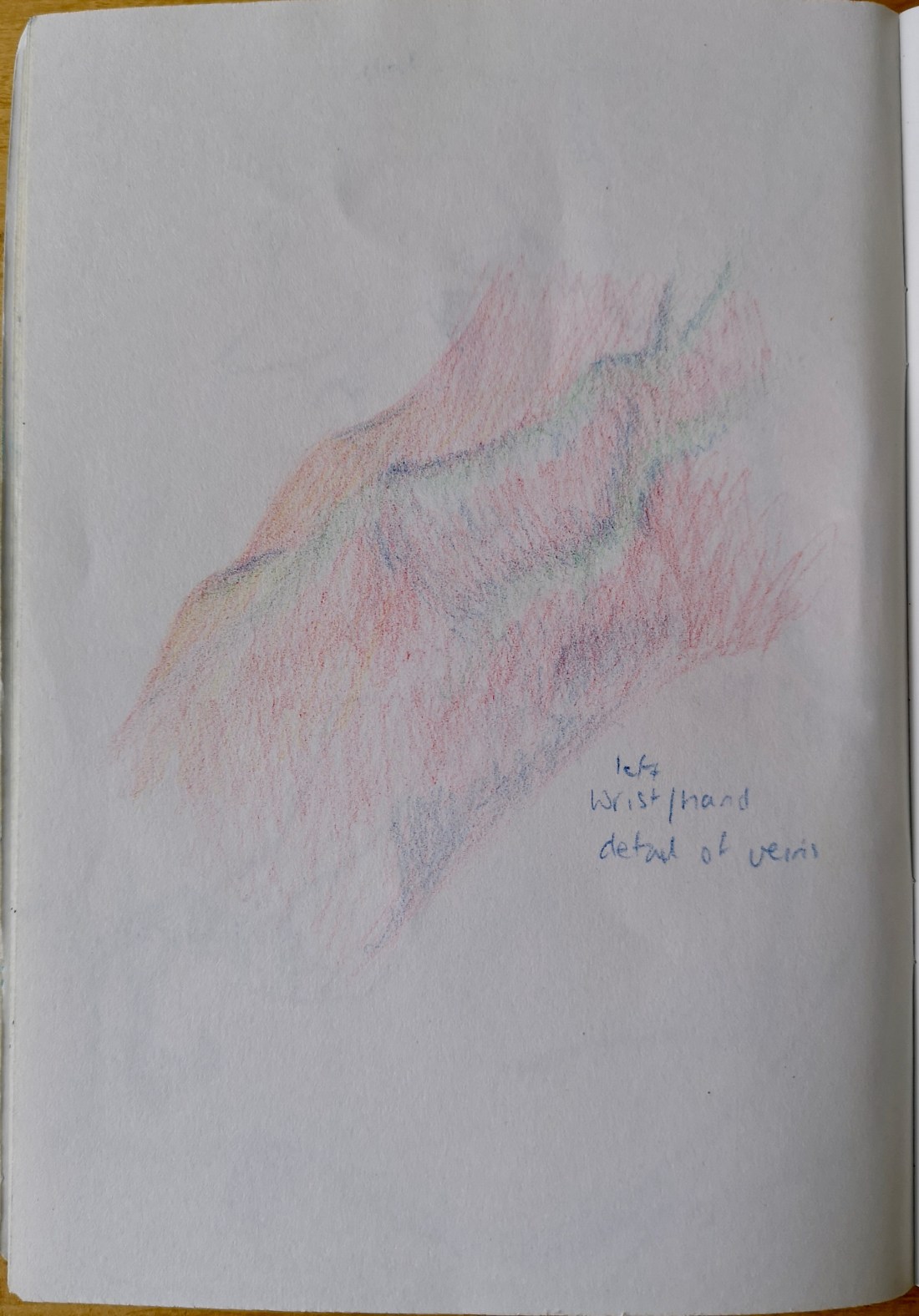
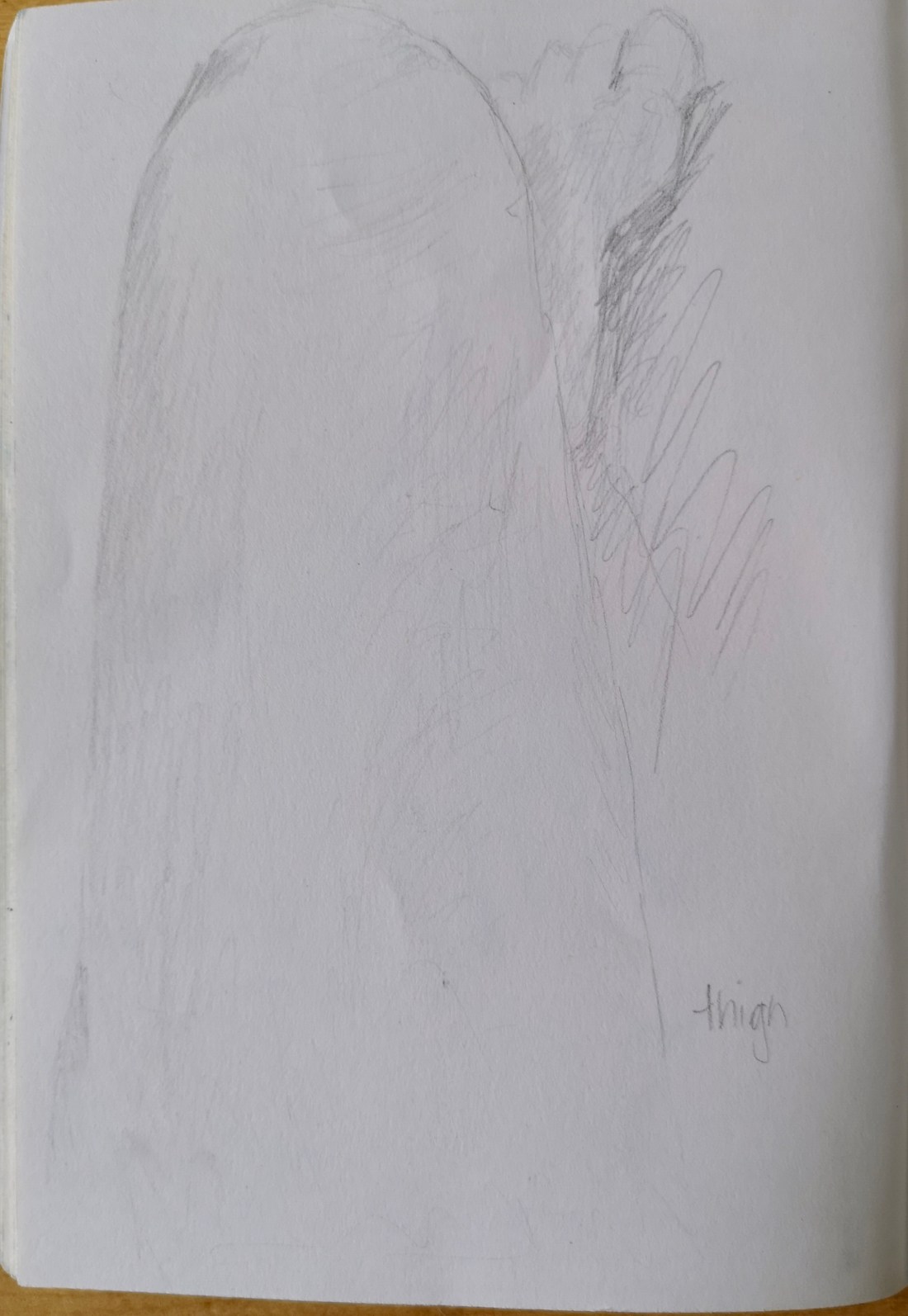
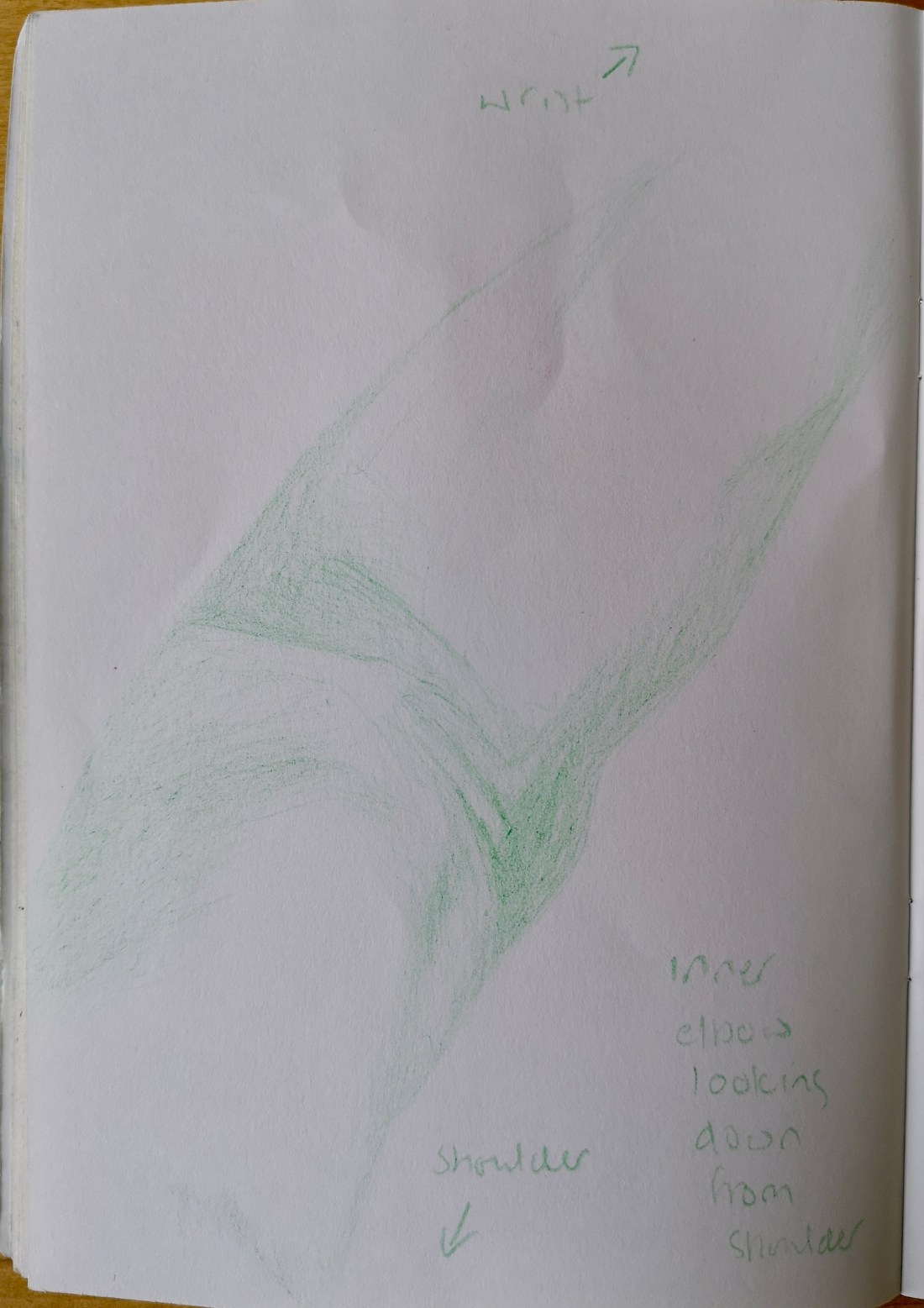
For this exercise I looked at how to guides and online images of human form and structure. I found some simple guides but found it most useful to observe and draw parts of my own body from different perspectives whilst giving consideration to the underlying structure especially in my hands and feet.

My drawings are below, most with notes to explain the image where it may not be apparent.

8A204D83-E14C-4E19-9256-2A211A5E55EB

EDF565CE-EC49-458E-B1CB-AA01575BEF22

Blah blah

05022601-91F3-4D5C-8CE5-332762CA4DED.jpeg

Blah blah

63B01B67-4DE6-49B8-B936-4597DB96920C

Blah blah

C57E4E2B-C858-4B2C-AC75-DA566B5EA919

Blah blah

449D89D9-CBEB-4584-A3D4-536A8AE72C1E

Blah blah

77B67DCF-B536-4092-8F45-8E8307BED8DD

Blah blah

80256526-97E9-4016-8C8F-745062995CCD

Blah blah

3245EBAA-42D8-45E4-BE92-29AE8FBE6BFA

Blah blah

FD5C0DCD-DFEE-400E-9E7A-AF7C1E2CF190.jpeg

Blah blah

B0244B6A-F397-41EE-9D75-B942CC765C41

Blah blah

A5F295FA-304C-4957-B4C5-1476E84B002B

Research Point

The most famous historical artist to have explored human structure who comes to my mind is Leonardo da Vinci. He is considered a genius of his age, with his talents famously extending way beyond art. This included his scientific investigations of the human body, he had access to cadavers and was able to examine these in the pursuit of greater understanding of the human body and its internal structures. This resulted in a significant body of drawings and notes of these investigations. He is noted to have explored the structure of the human form in much greater depth than his contemporaries, providing a much greater range and depth of understanding; his aim was not just to be able to better represent the human form in art, as many of his writings explore the essence of the human soul through these investigations. This for me puts his art into better context as it is from this understanding that I can see that it was the combination of movement and expression in his paintings which breathes life into them and gives a sense of personality and feeling from and between the subjects.

With regards to contemporary artists, I looked into the artist Jenny Saville. I was aware of her very large scale paintings of nudes which challenge female representation in art. Reading further about her I was interested to find that she was particularly drawn to the structure of skin and it is this in particular which drives her art. As part of her degree studies she spent time investigating this subject by observing plastic surgeons at work, viewing cadavers and examined animals and meat. She is particularly drawn to the many properties of skin – how it behaves and moves in containing the human form as well as it’s function and qualities such as stretching and healing. It is clear to see this fascination in her work, but unlike Da Vinci she is not purely concerned with simply capturing a likeness of the human form and condition, but rather in challenging and exploring it further through her art.

References:

Gagosian (2019) Gagosian: Jenny Saville [Online]. Accessed on 19/10/2019. Available from https://gagosian.com/artists/jenny-saville/ 

Grange, S (2015) Leonardo da Vinci: Masterpieces of Art. Flame Tree Publishing, London.


Drawing Skills 1: Pt 4; Project 3 Form – Ex 4 – Energy

Initially I had some difficulty with this as what I envisaged in my head was different in reality.

The first attempt was therefore quite lame (first image below) – even the position adopted was not very dynamic. I was more successful when I actually showed my model examples from the text book of what was sought and he helped in coming up with a pose which was almost in mid flow of movement (second image below).

14CA2579-5AA2-4D6B-8C7C-811EB9BF68AD

1E9CBF76-B60F-444D-A36D-A2388A9D1C91

Although I was happier with the second image I felt I could gain more, and therefore asked my model to make the full range of movement whilst I took several photos. I consider this to be cheating somewhat, but in reviewing those photos I was able then to produce the sketch below which I felt was much more dynamic.

dav

I was most happy with my use of shading and blurring to help show the reach back as well as potential movement of the model. I’m a bit disappointed that I used photographs to aid this exercise, but I think it was in fact a good combination of both live observation and photography that produced the best result.

Drawing Skills 1: Pt 4; Project 3 Form – Ex 3 – Stance

For this exercise I was tasked to draw several quick studies of my model in a standing position. Again he found it challenging to pose for long periods so I just completed 4 poses. I had to keep in mind the line of balance or centre of gravity in each pose and whilst I did not draw this in, but found this quite easy to locate, in part because my model did not sway to far from a central stance.

I was quite pleased with each of my sketches as I felt I managed to capture the stance quite well and just with very brief lines. Each sketch took less than 2 minutes and was completed with coloured pencil on A3 paper. The only thing I did find, was that despite having what I considered to be a relatively large sheet, I never had enough room by the time I got to the feet. I always start with the head but it seems that from this point I am not good at judging the whole scale so do not have enough room left when I reach the feet, this is different with a longer study as I would usually map out the whole picture before continuing – it seems though with sketching I need to find a quick way to scale the whole image at the outset.

B6CF02C2-71E0-4AAB-9DE2-4D70E641A271


6290F63D-A124-4BDB-AD18-EE7DDCBFC680


B990F339-36C7-4809-B5D9-CE09267BDFE8


349C5CE7-9E8E-49B3-8433-FB565C3B883F