I was thinking about this exercise for a few weeks before starting. I was keen to make sure that I channelled the emotions rather than illustrate them. I had a lot of anxiety about being able to do this and thought that I would likely need to space the exercises out in order to completely engage with it.
I decided to use one colour across the mediums as I wanted to be able to make direct comparisons; I felt that variation in colours may influence how this would be interpreted and detract from the media. I selected black and used an oil pastel, marker pen, ink and chop stick, and a willow charcoal stick.
1. Anger
I decided to start with anger. This is an emotion I am familiar with and wanted to get it out of the way first, I anticipated that it would be quite emotionally draining and found that as I was preparing myself my anger started to build, I was starting to envisage myself using the different mediums and without expecting it I started to worry as to whether I would be able to translate this onto paper.
Oil pastel – I was immediately drawn to pressing the stick onto the paper as hard as I could and just directing it straight across the paper. I repeated this several times and began then to get really absorbed into the process. However, more than once the paper slipped as I was not stuck down well enough, which meant I had to stop and res stick the paper. Half way through the end of the stick broke which served to help me channel the emotion further as I was able to press even harder on the broken pieces and essentially smear it across the paper. As I continued and the broken pieces wasted away I was then drawn to just continuing the motions with my fingers and rubbing across the marks I’d already made. I found it difficult to keep inside the boxes and had to really discipline myself to do this as the medium was very easily worked and maintained its consistency across the paper with only a very small amount used.
Marker pen – I found it very difficult to get started with this as the look and feel of the medium was very different to the oil pastel. It was a relatively small nib and I could only think of it making small marks which was counter intuitive to how I was feeling. I therefore had to pause for a while before continuing. After a few moments I started to make very small circular marks building into a large black circle, but very soon this did not feel right and I started again to make repeated lines which increasingly grew longer. As I did this the marks became lighter as the ink dried, this therefore made me want to press harder and as I did the pen became damaged with no difference to the intensity of the marks.
Willow charcoal – as I took the charcoal in my hand I felt this was immediately too fragile for anger. I was therefore drawn to crushing it under the heal of my hand and dragging the charcoal across the page. Again my instinct was to direct the medium in lines up and down and across. I was disappointed though as the tone of the colour produced was quite light and did not seem to match the amount of pressure I had applied; it did not look like it matched how I felt as the marks made appeared as though they could have easily been made with much less pressure which was inconsistent with my anger.
Ink and wooden chop stick – I really did not know how to approach this medium at first but then decided to dip the wider end into the ink and press it onto the page, from there I was again drawn to drag the ink in lines up and down the page keeping the end of the stick flat on the page. I had to keep dipping the stick into the ink which seemed to interrupt my flow and I tried at times to disregard this, instead just carrying on without the ink. This built my frustration and as it did so the pressure I applied became harder. This again lead to the page slipping and then eventually I accidentally made a rip in the paper which stopped me in my tracks as I had not expected this and it made me draw back on the intensity of my feeling. Afterwards, looking at the marks made is strange as I did not feel a connection between this medium and the anger, however the visual effect did seem to resonate with the emotion.
The image below shows the outcome of my mark making for anger; clockwise from top left oil pastel, marker pen, willow charcoal, and ink with wooden chopstick.

2. Calm
After reflecting on my mark making using anger as an emotion, I felt able to move onto another emotion and was drawn to calm – I felt much calmer after the first exercise – perhaps it had a cathartic effect, I was quite surprised as I had half expected needing to leave the rest of the exercise for another day. I also hadn’t given much thought to how emotions other than anger would translate so I didn’t know what to expect now.
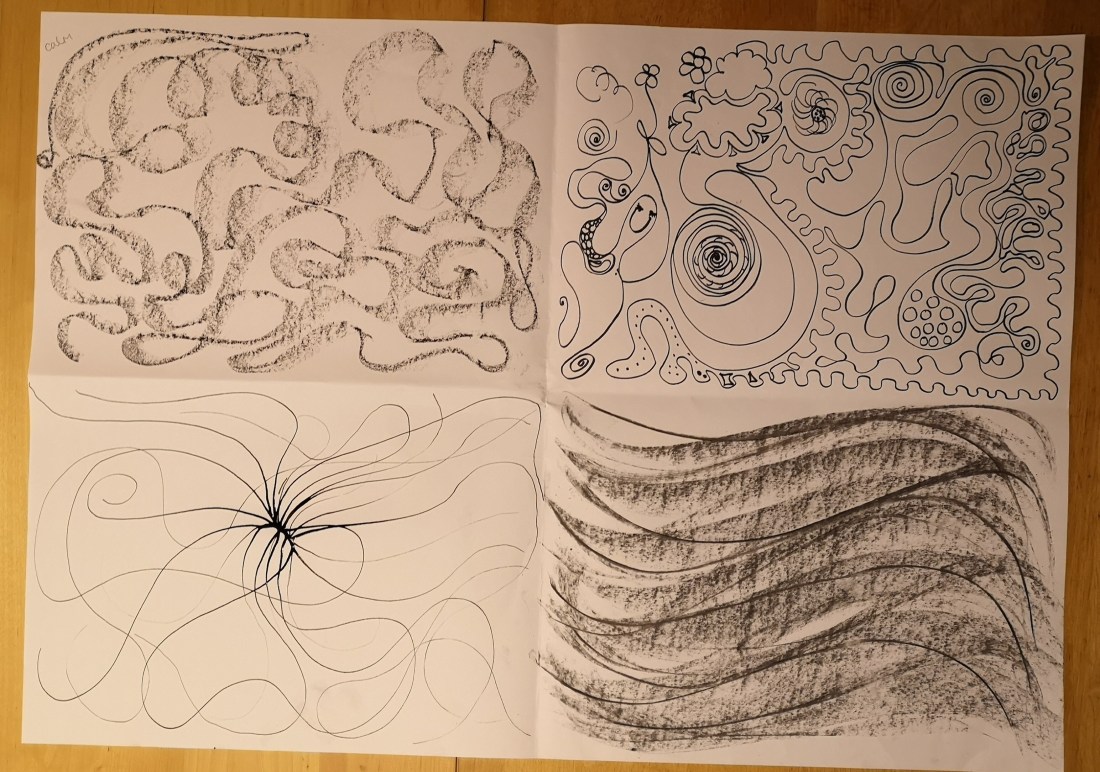
Oil pastel – I found myself naturally drawn to using this in a much softer way and to drawing waves, I was thinking of mindfulness practice and how listening or watching the sea always feels calming to me. As I listened to the stick moving across the paper it was also reminiscent of the sounds of waves on the shore. I felt incredibly relaxed as I just let the stick move across the paper, I found it hard to stop as I just wanted to keep going.
Marker pen – holding the pen instinctively made me want to draw, and I was urged to make more elaborated curves and shapes and to decorate these. I felt completely absorbed in filling the space with different wavy lines and spirals, as well as feeling the emotion driving my movement, I felt a sense of calm being perpetuated through what I was creating. I found I spent the longest time on this medium, however when I looked at the finished result I thought it was more illustrative, which was something I had wanted to avoid.
Willow charcoal – I was drawn to create wispy lines with the charcoal, I used the edge of the stick and at first the lines could hardly be seen so I had to press harder. Again I felt I was being drawn by imagery of the sea and waves and therefore found myself creating several wavy lines across the page, after a while I felt there was no distinction between the lines so the waves could not be seen. I therefore varied the angle of the stick to create differences with the lines. Again it felt as though I was trying to illustrate the emotion and I did not feel as engaged with the emotion whilst using the charcoal.
Ink and wooden chop stick – I was unsure what to do but felt I wanted to start in the middle and spread outwards, I felt the thinner end of the chop stick was more appropriate so dipped this end into the ink and placed it in the middle of the page. As with the other mediums I again instinctively drew wavy lines; however each time I returned to the middle of the page and drew the ink outwards. I had the most engagement with this medium in relation to this emotion, it felt the most instinctive and natural of all and I felt the overall result was the most consistent with how I felt during the process. The lines created were very gentle and free flowing and even where they crossed over do not give a sense of being tangled or confusing.
The image below shows the outcome of my mark making for calm; again clockwise from top left oil pastel, marker pen, willow charcoal, and ink with wooden chopstick.
3. Joy
I used photographs of family and some favourite music to evoke a feeling of joy in preparation for this part of the exercise. I then naturally found that my mark making tended to move with the music. At first I tried to resist this as it seemed to result in messy and disorganised outcomes, but then I allowed myself to just go with the flow.
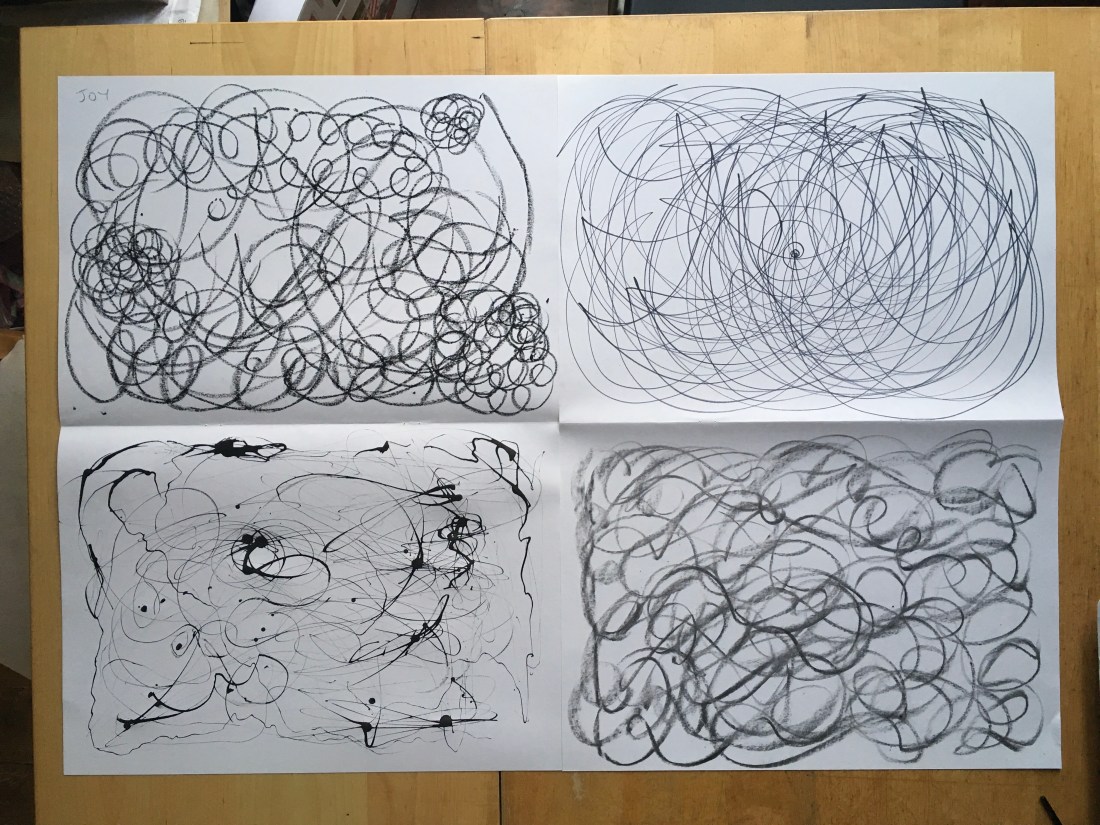
Oil pastel – as I said above I found myself naturally moving the stick across the page in line with the music, this manifested as swirly lines, I wanted to resist the circular movements as I was moving very quickly, making marks over marks which I felt started to look messy and not like ‘joy’. However, I quickly overcame this and just went with the spirit of the emotion I felt and where it took me. I tended to use the tip of the stick at a slight angle and did not press hard, my urge was more to move quickly across the paper and cover the whole area and as a result I was finished very quickly and spurred on to the next medium.
Marker pen – when I started on this corner the movement of the music had changed slightly which resulted in me making large sweeping crescent movements from side to side, as I did this I realised it looked like large repeated smiles across the page. I did not press on the pen very hard, but found the tone of the marks to be quite consistent and the pen glided easily. Again I was very much driven by the music and compelled to move quickly and cover the page, as I finished I also felt the urge to make a small spiral in the centre, as if it were a full stop to the image I had made.
Willow charcoal – with this medium I was instantly driven to move in the same way as I had with the pastel. I held the charcoal at an angle and again glided across the page. The charcoal felt very soft and whilst I wasn’t aware of changing the pressure I applied, I noticed that the marks had more of a range of definition and tone. Again I moved very quickly and had covered the page in a very short time.
Ink and wooden chopstick – I was quite aware that I could not use this medium in the same way as the others, therefore I hesitated a bit as I tried to figure out how I was going to start. I felt an urge to drip the ink across the page and move it around with the stick, but it did not drip easily from the stick so I had to be quite forceful in getting this to work. I then used different ends of the stick to draw the ink around the page, this time I wasn’t so driven by the music but actually felt more playful and motivated by joy to experiment and make different marks. I spent the most time on this part and enjoyed it the most.
The image below shows the outcome of my mark making for joy; as before clockwise from top left oil pastel, marker pen, willow charcoal, and ink with wooden chopstick.
4. Sadness
I chose the last emotion as I felt it was something I could easily identify, and draw upon for the exercise. My father died last year and I therefore re-read a poem that we had found and used for scattering his ashes. It immediately brought me to tears and I then found that I did not have a desire to make any significant marks on the paper. Feeling sad brought with it an apathy and feeling of disconnect.
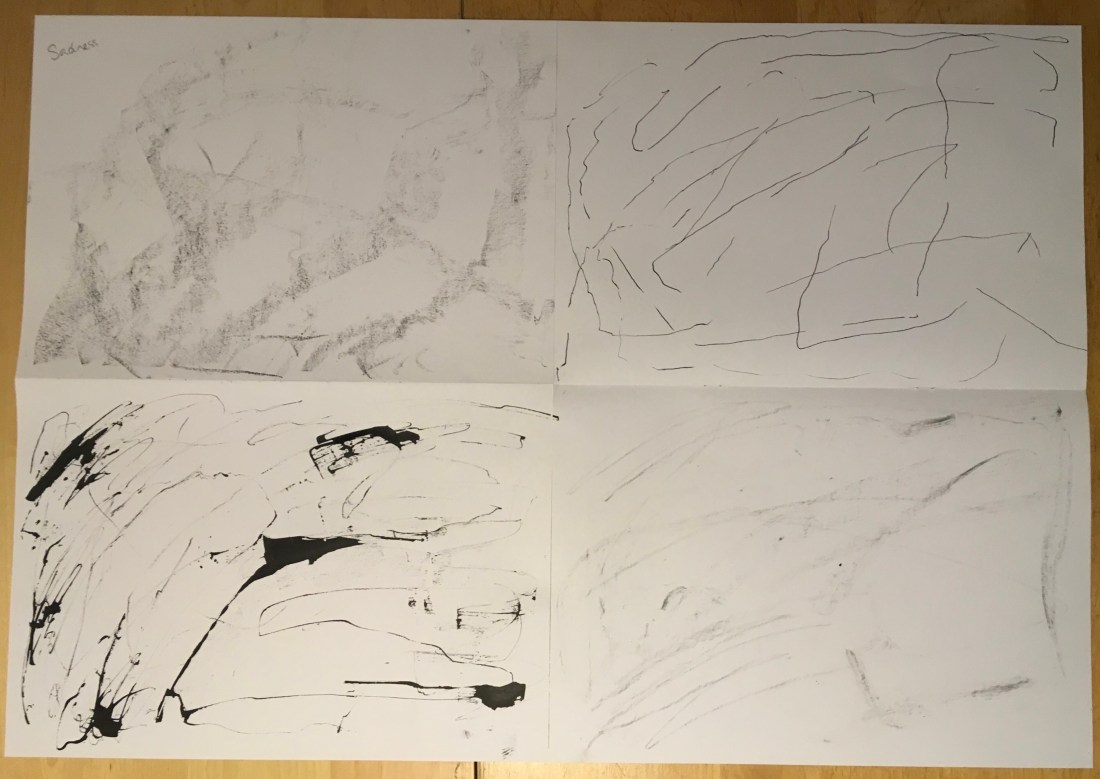
Oil pastel – I moved the stick on its side across the paper, I wanted to make the least mark on the paper and I was not really interested in where the marks went but felt myself moving the stick upwards and along in a random way. I didn’t feel any desire to fill the page, but after a while became concerned that the marks were all in the same direction and that it somehow did not appear sad enough, almost as if I was feeling guilty – I think this may have been because I was drawing my sadness from grief and guilt is a common feature of grieving.
Marker pen – I was really concerned that the pen would produce marks that were too heavy for this emotion. I therefore turned the nib on its side and almost dragged the pen randomly across the page in different directions which produced wobbly and interrupted lines. I became lost in what I was doing, feeling empty and not really caring about what I produced.
Willow charcoal – I really struggled with this medium, I found that the stick required much more pressure than I was willing to apply, I ended up lying with my head next to the paper and just moving my hand back and forward across the page in a listless manner. I realised that the paper was probably too smooth and did not have any teeth for the charcoal to work against.
Ink and wooden chopstick – with this medium I tended to use more of the stick. I used the wider end to dip into the ink and apply to the paper I then dragged this along the paper in wandering movements. I held the stick from the opposite end with the stick flat against the paper to make the movements, in this way I was applying the least effort to make marks. With this medium I felt myself becoming more lost and absorbed in my sadness, sometimes I felt compelled to concentrate on expanding the black areas and other times I just wanted to move the stick across the whole page creating thin, meandering lines.
The image below shows the outcome of my mark making for sadness; once again clockwise from top left oil pastel, marker pen, willow charcoal, and ink with wooden chopstick.
On reflecting on the whole exercise, I was quite surprised at some of the outcomes. In particular I was very disappointed with the lack of significant effect I seemed to get from the charcoal. This is a medium I have used before and enjoyed, however having said that I feel it may have been a lot to do with the paper I used.
I was most impressed by the ink – I had never really used this medium and was really taken by how the act of having to repeatedly apply the ink, actually helped me to get more absorbed into some of the emotions rather than always hindering them. I also felt the pen was more dynamic than I would have expected, despite having an almost constant tone I felt I was still able to use it to convey a range of feelings.
Overall, I found it very interesting to see and experience how emotion can influence drawing. I understand and recognise in terms of mental health and wellbeing how emotion can be exhibited in behaviour, but in art I had probably thought of emotion as being shown mainly through the subject or colour of a painting or drawing and assumed that different marks were generally made for the overall aesthetic effect. I think this exercise has also helped to me to consider the benefit of channelling emotion to produce different effects and its something I hope to explore further through my studies.
 Deborah McAulay