Personal Project
1. Self assessment of previous assignments and coursework
At the start of this process I really didn’t know how to progress beyond repeated practice. I felt like I was waiting for something to click as my thing or my style. I didn’t feel I have a particular style or way of expressing myself beyond recreating what is in front of me, but I when I try to realistically draw what I saw I seemed to be most successful. However I did know that I wanted to stretch beyond this and give more depth to my art.
I realised that to reflect more effectively I needed to set out a process and try to step outside myself to see my progress or what I needed to work on beyond the very superficial.
Therefore I decided to go back through my WordPress site and re-read my reflections, look at the work I had posted and check for any unfinished work either from course exercises or my tutor’s feedback. I also made some judgements as to what I felt were my best pieces and tried to summarise common themes/areas for development which I found in my practice across the course. I also decided that i would make notes of how I felt during the process and that I would try and draw or sketch anything that i felt inspired to do as I went along, as a means of keeping an open mind to creativity.
Part one – Form and Gesture
At the outset of the course, I had intentions to completely embrace the projects and was really pleased with my initial experimental pieces – both my approach and the outcomes. I also liked opening my mind to the concept of what a drawing is and began to look more intently at the world around me and to ‘find’ drawings in nature or the environment around me. However, as I then moved into the more structured and conventional drawing exercises I seemed to lose this. I felt like there is a disconnect and as soon as I am asked to draw a subject I resort back to type. This was something I noted and reflected on in my first assignment.
I felt my best pieces at this stage were the mark making experiments and some of the found drawings I posted on instagram.
Feedback from my tutor included advice on ways to experiment, in particular to do a charcoal reduction drawing. I made an initial feeble attempt at this which didn’t go well and then pretty much left it on my ‘to do’ list. This time, I therefore took the bull by the horns and completed a self portrait using this method which I have included below.

I actually felt this was quite easy to do, despite the difficulties I’d encountered previously. Although the likeness was poor and I don’t think I put as much effort into it as I could have as I was not completely in the mood, I did find it helpful in terms of being able to remove and then add medium, then remove again, so essentially being able to err and not get too caught up in it, which was why my tutor had suggested it.
Part two – Intimacy
I really enjoyed this part which I did not expect. There was a lot of work, and I anticipated that the interiors part would be quite boring and that I needed to just get through it to finish, but I was quite surprised at how much I enjoyed and gained from it. I felt it was a genre that could say quite a lot and could offer a lot of interpretation. I also think this assignment piece was the one I am most proud of – in terms of research, composition and outcome. Also with feedback from my tutor I was able to improve it even more. This is definitely an area I feel I want to explore more, I think in terms of my reflections on part one there is also a lot from that part that I could bring to this genre.
Some of my thoughts at initial reflection at the time, were around my fear of managing backgrounds in my final pieces, but my composition skills improved and I tackled this at the time. I also found issues with working from photos. I do still rely on these quite a lot, but understand better their limitations and use live drawings more so for preparation and additional sketch book work.
I also became more aware as to how my mood can affect my work in terms of patience and perseverance. I definitely feel I have most improved in this area over the course by reflecting and pausing whilst working on a piece. Another significant change was to do with process in terms of the order of drawing and the epiphany of realising that art is about representation, it does not need to be literal reproduction. I continue to struggle with this and I think this is where I continue to get stuck when I am not happy at the end.
My best pieces were the colour drawing of garlic – this was my first experience using colour pencil with good effect; and the monochrome piece – this was my best ever attempt with oil pastel to that point. I also loved my assignment piece – as I have said, I feel this is the best assignment I’ve done in this whole module and I think was much improved afterwards using the feedback from my tutor.
I worked on all the feedback from my tutor, a returning theme from previous feedback was the idea of cropping an image. I had tried to address this by considering this more so in the initial composition, but my tutor reminded me of the idea that I could still revise a piece at the end by cropping.
Part three – Expanse
I hated this part of the course and I think that was evident in the work I produced. However, I find it is also a subject I keep returning to in my practice. I am drawn to landscape and find myself inspired to draw or take photos of landscapes or natural environment quite often. I am most inspired by colour, texture and patterns in nature.
My best pieces were individual studies of trees (although none were really complete studies) and one landscape drawing in pastel.
My tutor commended me for sticking with the subject matter. However, there was one exercise – a group of trees – that I never really felt I had done justice to, and throughout the rest of the course this was something that continued to niggle me. I found myself frequently looking at groups of trees that I found interesting and kept considering how I might tackle them as a drawing. I was also drawn to other drawings or paintings of trees that I happened to see over time and thinking about how they had captured what I had hoped to do.
Part four – The figure and the head
I was so keen to do this part, but struggled more than I expected. In particular I found it really hard to work large scale, I found the whole figure much harder than portraits and found self portraits impossible! I also didn’t manage to get to a life drawing class although my husband was a very willing clothed model and I have been to life drawing classes in the past.
Looking at my course material – I was most pleased with the small portraits I completed, and I did manage to produce a lot more sketch book work.
The feedback from my tutor was very constructive but I also felt somewhat deflated as she more or less recommended adding to or reworking all of my assignment. However, this turned out to be quite a godsend as I took so much time over the re-workings that I ended up with pieces I really liked and in the process I feel I managed to loosen up my approach considerably, which also had a positive impact and influence on my approach to assignment 5.
Below are some looser portraits and self portraits that I completed using a much looser approach.

Common trends and themes
Through the course to this point I feel I definitely was not explorative enough. This was something I myself expressed repeated frustration at and was also evident in my tutor feedback. Despite trying to work on this I remained too focused on the end result. I therefore think the biggest development need for me is to increase my experimentation process and to loosen up my style.
2. Artists Statement
‘Investigating mark making with mixed media to create tone and texture in landscape’
Towards the end of part 4 I had been giving some though as to what my subject for part 5 would be. I’d been drawn to my immediate interior environment and captured views of everyday subjects which had inspired me. These seemed to have the light and shade and the patterns they created as a common feature, so by the end of the part 4, I had initially thought this would be what I would take forward for my last assignment. However, through the course of completing a self assessment of my work, I realised that I had been carrying around with me some unresolved work which I was really driven to address. Additionally I found that the need to experiment more in my mark making was something that really niggled me – using more of an instinctive approach such as I had with one of the first ever exercises in the course. I felt these 2 things were something I could combine and address at the same time for my final piece.
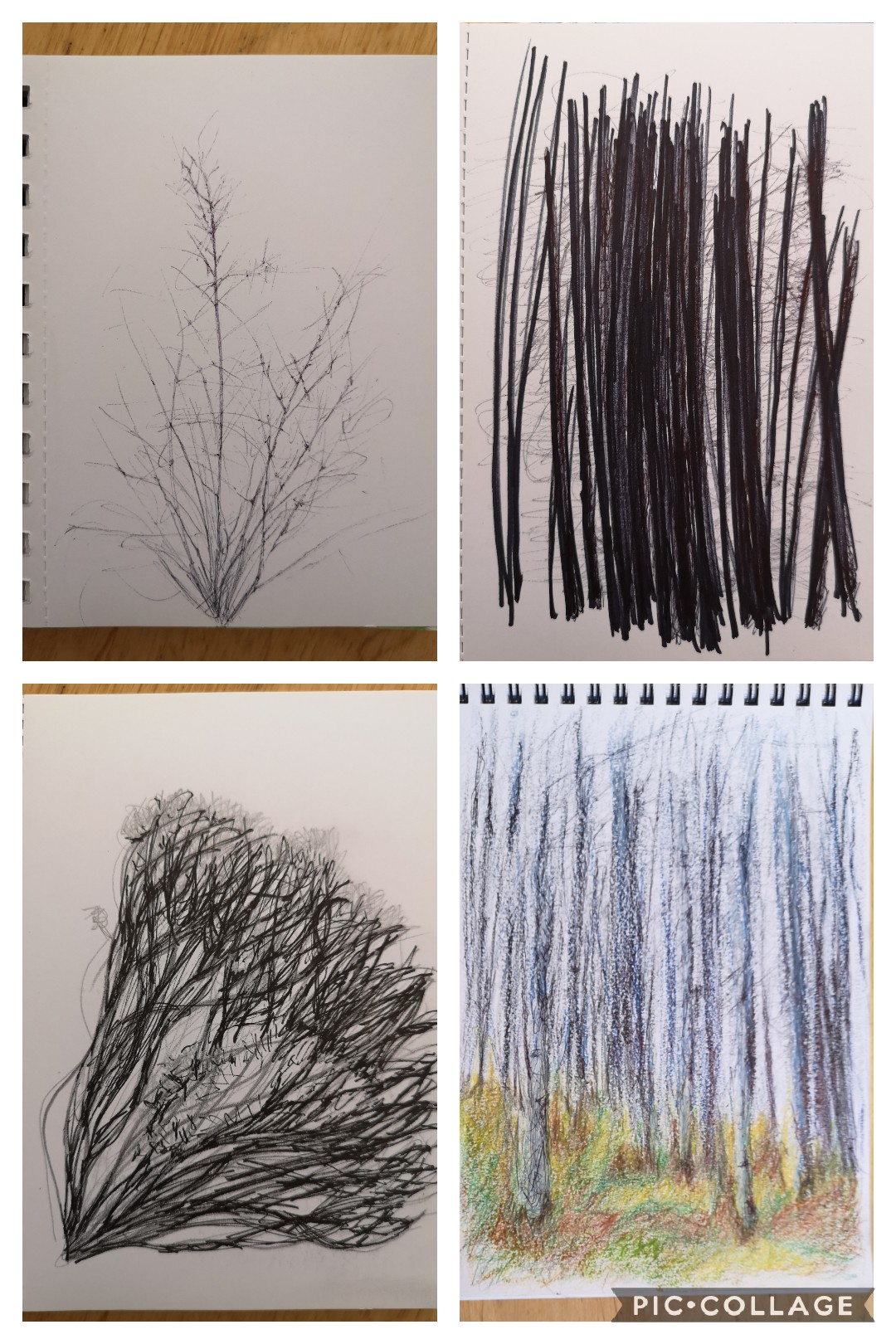
I began to explore this with some initial sketches, experimenting with different drawing mediums, lines, marks. These were based on what seemed to occupy my mind in terms of my vision of what I wanted to get across as well as taking inspiration from my garden, actual photos, images and recollections. I liked the freedom of not worrying about the results although I felt the results weren’t always that what I was looking for.
These sketches are shown below.
Whilst I was still contemplating how I was going to approach the assignment, I attended 2 exhibitions at the British Museum, one was Kathe Kollwitz prints and the other was a selection of contemporary drawings from 1970 to present day.
I was already aware of Kollwitz prints as I had a book of these, however this did not do the actual prints justice. I was immediately struck by the build up of texture and marks to intensity the darkness in the images. They were so deep and really communicated the emotion of the subjects, I couldn’t help but be drawn in to study the images and examine what was being depicted and to feel the harshness and agony.
The contemporary drawings exhibit – ‘pushing paper: contemporary drawing from 1970 to now‘, only had a select number of drawings to show how drawing has moved from just part of the preparatory process of painting to an end result in itself. It also demonstrated a wide variety of drawing styles and processes which was quite incredible when brought together in one place. Many of the pieces were very exploratory and personal, being part of the artists journey of discovery or expression and identity.
Two pieces really struck a chord with me only because they resonated with a style of drawing that I had begun to find myself practising following the process of self reflection. The first was a drawing of an artists deceased mother (My Mother Dead, 7, by Maggi Hambling) which was drawn primarily from emotion, the other was a more abstract drawing but made purely from the sense of touch (Drawing (head) 100, by Claude Heath). Both were very similar styles, quite wandering and fluid marks with pencil and pen not taking any particular form individually but as a whole building towards an image. I was struck by how they were both driven primarily by senses other than vision, and therefore more about feeling, as opposed to concerns about the end result. When I reflected on this I realised that recent sketches I had done in a more free flowing style were also more intuitive and receptive and that I had usually been much happier with the results. I was encouraged to experiment more and both exhibitions gave me more encouragement to continue experimenting along these lines for my assignment.
On the advice of my tutor, as I was now clearer about my chosen subject, I searched for artists which could help inspire and inform my practice further. I started with one whose work I had looked at earlier in the course; Joan Eardley. I looked at 3 of her paintings in particular – ‘Summer Fields’ (about 1961), ‘Harvest’ (1960) and Seeded Grass and Daisies (1960). All the paintings have an abstract quality to them and what I particularly liked was how they evoke a feeling of the image portrayed rather than an exact likeness, thereby drawing on the viewers own experiences through the use of colour and texture. To this extent she used elements of the outdoors to create textures in her paintings – bits of grass, grit and seed heads.
The second artist I researched was one whose work I had come across several years ago, Sarah Bee. She works in mixed media including the use of gesso to create texture. Again, there is an element of abstraction in her drawings although the features of landscape are more recognisable. I looked more closely at 2 of her pictures – ‘Pair of Limes with Ivy’ and ‘Limes by the Sharpham Path’. Both are very representative of the rest of her work. Her marks are very evident and follow the contour of the subjects involved. There is also a very blurred almost ghostly element which suggests movement and weather. Her pictures also include a huge range of colours, which don’t look out of place but are equally quite unexpected – such as bright blue, cerise and teal. Again her drawings evoke a sense of engagement and experience within the landscapes through the use of such emotionally driven marks.
The third artist I found by searching the landscape genre through Art UK. Her name is Bernadette Timko, there were 2 paintings which were untitled on her website with no date, but appear to have been painted with oils and look to be groups of trees and can be accessed at https://wwww.bernadettetimko.com/paintings. I recognised them as trees but again they were quite expressionist and slightly abstract in their appearance. What drew me to them was again the very evident marks and range of colours as if they had been well studied and were well known to the artist. They connected me to my own experiences with nature, which is what I am most interested in achieving for this final piece.
Each artists style I had very common features that I feel really capture what I love about landscapes and what I yearn to be able to capture. The main elements for me – were colour, variety of marks and texture.
Final piece
I started experiments on a small scale using a range of mediums. For my first experiment, I worked on normal cartridge paper and used ink for the background – emulating the sky with blue for the top half of the page and green lower down with blobs of yellow. I did not follow any particular form or reference image but had recollections of landscapes in my mind. The ink was quite runny so I blotted it with a paper towel which worked really well. When dry I then did some twisty random lines to represent trees, using gesso. When that was dry I took dark brown pencil over the background ‘trees’ and I liked the way this worked. I then noticed that the foreground colours tended to denote lumps of moss and grass which I used coloured pencil to accentuate and build more colour and depth into. I then used more pencil colours over the trees including the foreground ones to add more interest. The final stage was to scribble over with black ball point pen to give detail such as bark and twigs. I tried very much to let the image evolve and not plan ahead, rather to take each stage at a time.
Lastly, I tried to make one side of the background darker and the opposite side lighter with some success but on reflection felt I may be able to do this with better use of the ink at the beginning. I also thought about using other mediums at different stages to produce different effects so did a few more experiments.
I completed more experiments using mixed media paper, but didnt really like how this worked as it seemed to restrict teh ink from spreading and really muted the colours. I also used different tools for applying the gesso, using a stick was good for giving sense of dense trees in the background but I felt a brush worked best for giving a sense of a twisty foreground tree. I used watercolour pencils as well, and in comparison to inks i could control them better but the outcome was much softer and blended rather than bold and dramatic.

I reviewed all 4 images to discern what I liked best about them for going forward. I liked the moodiness that I gained from using watercolour pencils as well as the bright colours from inks, the inks also felt very like the soft mossy carpet of the many forests I’d walked through. Using gesso was very good to produce added texture for trees and I found that I could use pencils and biro to add to the texture and give a range of colour and depth.
I felt my experiments were successful and decided to plan a composition using a photograph as reference. I felt that whilst I didn’t want to be rigid with replicating a scene, I needed a reference for direction of light and perspective. Due to the time of year I was limited in the amount of outdoor time I could use for completing this, so my photographs would be useful in combination with past sketches and experiences.
I made a few thumbnail sketches of possible compositions and decided on a landscape composition and made notes on proposed materials I intended to use for the background – watercolour pencils for the sky and forest background interior, and inks for the ground. I then intended to build the forest in layers using gesso, and to use different coloured drawing materials to add tone. I hoped to allow the image to evolve.

I decided to use a tinted, textured cartridge paper at just under A3 size. I started the drawing as planned. I realised quite quickly that i started to refer to my reference photo to often, so had to remain mindful to keep an intuitive approach which i think I managed to balance in the end. I took pictures at different stages to help with reviewing progress throughout, I also took my time in an effort to ensure that i did not overwork the piece.
Images of the stages including the final piece are below.


Below is a larger image of the final piece.

Even though this is a final piece I think in itself it is also a starting point for further exploration and experimentation. The fact that I used the textured side of the paper was an accident, I did intend to use the smoother side, so I am still interested to see what difference this may have made. I also feel that I could experiment further with texture using different tools to create this, and widen my palette in terms of colour which was limited at this time by what I had available. I am still much further from more abstract images so have a long way to go in terms of developing a more intuitive and reactive approach. There is also potential to increase the range of medium, perhaps a larger size would enable this although I feel less equipped to keep perspective of a very large image as I have not got studio space.
 Deborah McAulay