Tonal exercises
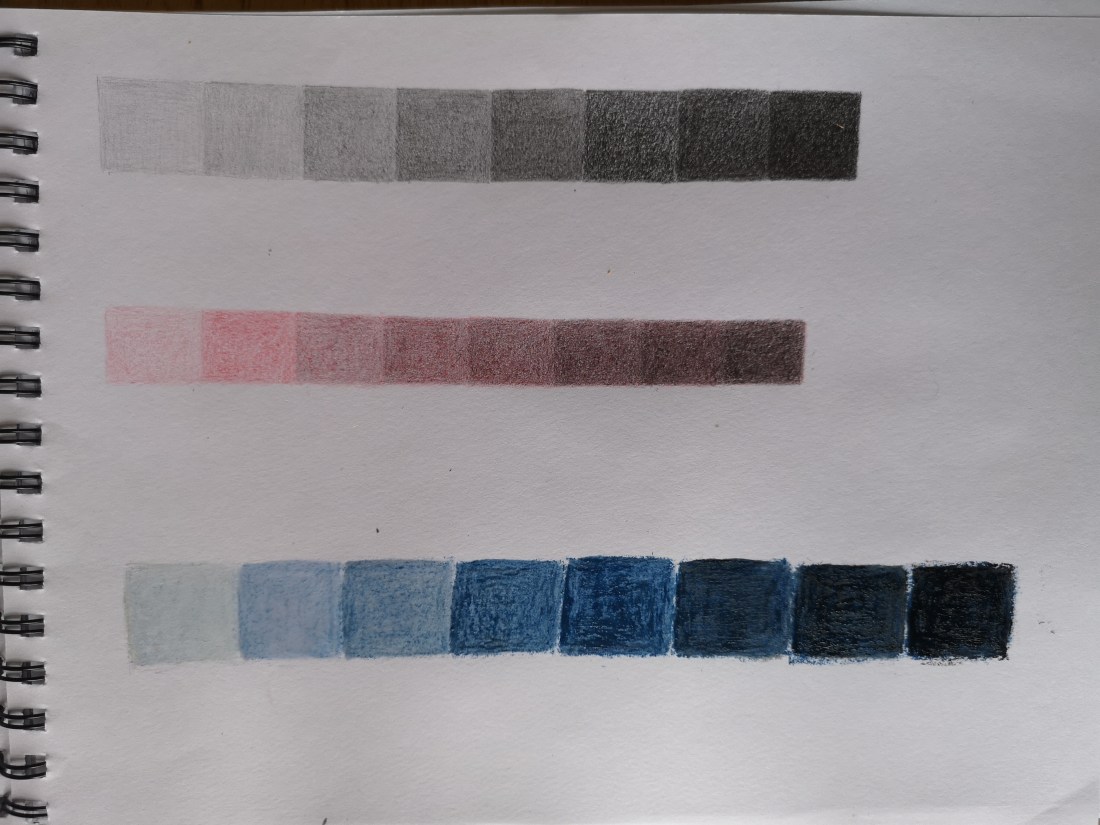
My tutor advised me to do some tonal exercises to help with developing my skills in this area. I looked into an exercise suggested in the recommended reading material. This suggested creating 8 boxes of equal size, and to try to create an equal tone across the box from edge to edge and an equal increase in the variance of tone between each box using the full range of B pencils.
I started this exercise with graphite pencils but didn’t have a full range – I only had B, 2B, 3B and 6B, however I decided to proceed anyway. I found it easier to do the first few boxes but as the tone got darker the difficulty also increased. I also found retaining the equal size of each box and ensuring equal tone across the box very difficult – I found I was concentrating more so on trying not to press too hard on the pencils.
I repeated the exercise with coloured pencil (adding graphite pencil to build the tone) and then with oil pastel using the colour of blue from my assignment. In discussion with my tutor I had identified my struggle to see beyond simply adding black for the folded areas in the gown I had drawn. I blended the pastel with white grey and black to achieve different tones but again I think I had greater depth between the first few than last few boxes although consistency was better across each box. I do think that I managed to retain the blue colour, which I feel is progress.
I could have probably spent longer on this or done more exercises, but I think in all it’s taught me that tone is something that needs a lot of time and consideration. I often become impatient with my work, particularly if it is something which takes more than a few hours – as my assignments often do. I need to consider tone as importantly as I have been considering negative shapes and spaces. I think it is perhaps something that I can expand on and build into preliminary work prior to any assignment in order that I am not using the final piece itself to work issues out.
Review of research
On the advice of my tutor, I went back over my original research exercise recorded in an earlier post ‘Drawing skills 1: Pt 2; Project 3 At home – Research point’ and considered the images again in terms of materials used, composition, colours and how they generally made me feel.

Egbert Van Heemskerk II, Interior, 1634/1635 – 1704 (oil on canvas)
This painting focuses on the characters although there is evidence of it being an interior in the painting scene and it’s title. It is very dark with light used to highlight the roughness of the characters in terms of their physical features, expression and clothing. The medium appears to have been roughly applied as if to speak to the subject matter. I like that it seems to have caught a moment rather than having been posed. I suppose at the time it would have been something unusual for a painting as it was a chronicle of the times, not a usual subject of paintings, rather than a display of someone’s wealth or a means of relaying a message of religion or teaching in morality. It’s hard though to try and understand that context when in this day and age real images of real people whether in their everyday lives or even in the midst of disasters and cruelty are so common place.

Theodore Matesfdorf, Interior, 1888 (oil on canvas)
In comparison this image seems to display what may have been thought of as a good example of a woman. The way the same medium seems to have been used in such a different way to create a serene and calm image of a young woman enjoying an appropriate pastime; appearing to know and accept her place and to be a pleasing subject for a painting. In contrast to the first painting the light is used to create softness, to accentuate the feminine features in direct contrast to the heavyily shadowed corners. I notice that the women’s dress is almost the same colour as the statuette behind her, almost casting her as an object of art within the painting. A wider range of colours are also used, also with a greater number of other features in the room – nice furnishings, other works of art – seeming to appeal to someone interested in their status or even if displayed publicly to reinforce the eleveted position of people who have such interests. Although I am in awe of the painters ability, I really dont like the picture at all, it seems dull especially in contrast to the previous painting – even if it was capturing a moment in time and not staged as it appears, I am not interested in the view; it bores me and I dont think there is anything interesting about it – it is a subject frequently presented in paintings and I would be more interested to know who the subject is and what she felt about the picture and her experience of her involvement in it.

Edward Le Bas, Interior, 1951 (oil on board)
The above image I found more interesting for many reasons. I love the colours used and the way the painting is applied. It has an appearance of impressionaism and the details in the room are beautiful and appeal to me. Thinking about tone in this picture, at first glance it appeared that there is no shadow as the colours are so vibrant, however on closer inspection it is evident that the tone is very well applied maintaining the vibrancy of the colours rather than casting everything into dark shadow. I also feel that it appears to have caught a moment in time and whilst the woman appears to be portrayed in a similar manner to the painting above, there also seems to be a hint towards her inner self, and thoughts as if that is the purpose of the painting. I also feel that the painting is more like an attempt to document a moment and is not just interested in creating a pleasant picture or preaching an ideal.

Francois Bonvin, Interior, 1817-1887 (oil on canvas)
The colours used in this painting appear very minimal, this may be due to the limited palette available at the time. Again as with the first the painting, the medium appears to have been applied more roughly as if trying to be sympathetic to the nature of the subject. However at the same time there has been careful attention given to things like the shine of the metal and glass and the textures of the wood and brush. Whilst it is a very dimly lit subject the way it is painted gives great depth and interest to the objects as if to elevate them to a more interesting status than would be assumed if they were seen in real life. I do like the painting and I think I am more drawn to the way it is painted than the actual subject. I feel it draws me in to look more deeply at it, and the objects and setting therefore become much more beautiful than would perhaps be the reality.

Vanessa Bell, Interior, 1879 – 1961 (oil on canvas)
This painting again has a very impressionist style. The paint is applied in a more loose way and again at first glance appears to lack tone, but on further inspection this has been very cleverly applied so as not to lose the light and colour of the subject. There is very little detail, but enough to know what is portrayed and whilst it shows an interior the painter encourages you to look beyond and to the outside. The colours are very soft and inviting, there is no heavy darkness but it does not detract from the painting – although this is in contrast with the previous image, I am just as interested to look at the subject and consider it in more detail, although it is quite a mundane everyday subject.

Diana Cowdy, Interior, 1968 (oil on canvas)
I find this image quite interesting as there appears to be a lot of detail whilst at the same time there is not. There is a very light aspect to the painting as well, with a lovely mix of dark and light colours. The whole painting seems to have a very sketchy appearance and seems as if it was completed quickly with the intention of simply recording the view rather than having the primary purpose of being a painting. I can’t help but like it, but at the same time I don’t want to because I’m not interested in the subject matter, again it is a view often captured in many paintings – how the other half live, what we all should look up to.

Margaret Ann Lemon, Interior, 1967 – 1973 (oil on canvas)
I love this painting. It is oil again but has been applied in a seemingly completely different way to the other images I looked at. The brush strokes are less obvious and there is more attention to line rather than tone whilst still managing to appear very real and to have depth. I really love the subject, it is the type of view that I would find interesting, I love finding interesting patterns and shapes in what is around me, and this really speaks to that. I also find it interesting the way my eyes are drawn around the painting – first to the window and the stained glass, then the bannister and doorway.

A Quigley, Interior, 1978 (oil on board)
This last image is again in an impressionist style. There is again limited use of tone but really lovely use of colour and perspective to draw in the eye and create depth. I like the ease of the painting and the natural style of it seeming to capture a moment in an very normal situation that most people could probably relate to. It is very similar to the Diane Cowdy painting, but using a overhead view adds something of more interest. I’m not sure I like it as a painting though as I cant help ignore the fact it is very obviously 1970’s which is an era I do not find appealing image wise!
Prior to re-visiting these images I had watched the 4 part Ways of seeing series by John Berger on YouTube. I found it really interesting and realised that most often I look at the aesthetic qualities of a painting, occasionally considering the context when it is obvious or specified. This series made me realise the responsibility and purpose for art in terms of social context. A lot of what Berger says I was aware of but I suppose not consciously so when I view art. I have noticed however in my own art that there is always an internal influence, in that it can change dependent on how I am coping with my immediate world around me; mostly that I find it difficult to produce art when I am low in mood or tired, but I have also found that my art is much looser and dynamic when I am in a really good mood so even this can change the context of what is seen. In this respect I am drawn to think of Van Gogh who is famous for having produced art which reflected his mood. However it also makes me think of art that is a response to what is around particularly where it is in response or relation to changing political and social context.
I also realise though, it is quite difficult to shake off years of conditioning as to what is considered nice or pleasing in terms of art and images in general. I also realise that I have personal tastes which mean I am drawn to some styles of art and images over others. However, understanding this and being aware of it does help me to refine what I find useful to my own practice and I feel that delving a bit deeper in my research and including my views on the whole image and how I feel about it is making me think about how I may be able to do this.
Further practice pieces to explore the competing textures/surfaces in assignment 2 final piece (hard door v soft gown)
I did not complete this piece of work for a few weeks, instead spending some time thinking about it. It seemed that I was allowing myself more time than I did with the actual assignment, which I found interesting in itself. I also felt that in contrast to the assignment I would use mixed media and considered what would be most sympathetic to the effects I was seeking.
I felt that coloured pencils would be best for the wood as I could build the different colours in the grain but also add detail – using pencils in different ways enables this. However, I did not want the effect to be too soft as I have experienced before, so also decided to use a coloured fine nib pen to pick out very small detail in the grain or wood edges here and there, and within the door handle which would also help identify the metal surface.
I stuck to a limited palette using bendable pencils (red, yellow, blue, brown, ochre, orange) concentrating on layering the different colours I could pick out. I added the detail of the grain as I went along, alternating between shading and detail until I was happy.
I decided that I would use a charcoal pencil for the gown. In one of my original practice pieces, using charcoal had been effective for this purpose. My only hesitation was that it would have no tonal colour, but I was also keen to overcome my issue with charcoal, in that I have not been happy with any pieces I have created with this medium and therefore had so far avoided using it.
I simply worked in darker areas of shadow with the charcoal and used a paper stump to blend and create the lighter areas. This gave a really soft effect which suited the gown and which I was instantly pleased with. This in turn gave me confidence to continue and to use the charcoal more purposefully as a drawing tool.
It sounds quite obvious now, but I realise that when things go well my confidence builds and I want to keep going, but in contrast if things don’t go to plan it knocks me severely and can put me off for days, in turn making me very hesitant about practising and experimenting. I have been trying to overcome this by just ‘doing’ and ‘going with the flow’ etc, which does help and I am getting better at. I also think that what has been helpful is working on other exercises at the same time (I was working through part 3 of the course), so that I am still practising some art. I have also found this can provide additional inspiration and the motivation to persevere.
The final image is below. I posted this on Instagram and received positive feedback which also helped boost my confidence.














 Deborah McAulay